
Much of the conversation about the future of customer contact is dominated by technology.
AI. Automation. Analytics. Bots. Faster. Cheaper. Smarter.
Yet when we step back and look honestly at where organisations are struggling, the challenge is rarely technology-first. It is people-first.
Most businesses already know what needs to change. The harder truth is that knowing does not reliably translate into doing. Strategy decks are written, tools are procured, pilots are launched – and still the outcomes lag behind ambition.
That execution gap sits squarely in the people layer.
The Gap Between Knowing and Doing
Across sectors, the pattern is remarkably consistent. Leaders understand that customer expectations are rising, that work is becoming more complex, and that traditional operating models are under strain. Teams on the ground feel it every day.
And yet progress often stalls.
This is not because organisations lack capability or intent. It is because many are still trying to solve today’s problems with yesterday’s assumptions. Training models remain largely ‘one and done’. Roles have evolved faster than the support structures around them. Managers are asked to lead a more complex, emotionally demanding workforce while being measured on metrics designed for a simpler world.
Holding the line on those legacy measures creates lagging outcomes – first for employees, and then inevitably for customers.
Future Fit organisations recognise that execution failure is rarely a technology issue. It is a people issue, reinforced by culture, incentives, and leadership capability.
The Agent Role Has Already Changed
The frontline role in customer contact is no longer primarily transactional.
Routine interactions are increasingly handled through automation, self-service, or deflection. What remains with humans is more demanding:
- Edge cases that fall outside standard rules
- Emotionally charged conversations
- Complex judgement calls
- Moments where reassurance, interpretation and empathy matter most
Yet many organisations are still hiring, training and measuring agents as if the job has not fundamentally changed.
Future Fit thinking starts with a simple acknowledgement:
the agents we need now – and in the future – are different.
They need stronger judgement, emotional intelligence, and confidence navigating ambiguity. They also carry a higher emotional load, often in remote or hybrid environments where informal support and loyalty are harder to build.
If we do not redesign roles, support, and leadership around this reality, burnout becomes structural rather than incidental.
AI’s Role: Reducing Friction, Not Replacing Humans
In a Future Fit model, AI is not the solution. It give the power to unlock it.
Used well, AI should make work more human, not less. That means:
- Removing friction from the agent day
- Reducing cognitive load
- Surfacing the right knowledge at the right moment
- Guiding decisions without dictating them
- Supporting judgement rather than automating it away
This requires intentional design. Clear purpose for each use case. Strong guardrails around how data and insight are used. Ongoing development rather than ‘set and forget’.
Crucially, it also requires honesty with employees. When AI is positioned as something being done to people, resistance is inevitable. When it is designed and communicated as something done for them, adoption follows. Ideally, it should be co-created with employees – let them see their fingerprints all over the final solution.
Future Fit organisations understand that AI does not remove responsibility from leaders. It increases it.
Metrics will set the mindset of employees – they send the message about what matters most. And these mindsets shape behaviour.
Culture Follows Metrics
One of the most common failure points in transformation is misalignment.
Technology changes. Roles change. Customer expectations change.
But metrics stay the same and still the investment in people lags.
Future Fit organisations are ruthless about asking:
- Do our measures reflect the work we actually want people to do?
- Are managers incentivised to enable value, or simply control volume?
- Are we measuring activity, or outcomes?
As technology takes care of the repeatable, human value becomes the differentiator. That demands new definitions of productivity, stronger coaching capability, and leadership that understands how to create space for quality, not just speed.
Culture does not shift through slogans. It shifts through what is rewarded, tolerated, and prioritised.
From Transformation Programmes to Continuous Evolution
There is no finish line.
Future Fit organisations do not treat change as a programme with an end date.
They treat it as ongoing evolution:
- Continuous improvement rather than big-bang transformation
- Listening deeply to employees as well as customers
- Taking analytics upstream to fix root causes, not mask symptoms
- Investing in leadership capability alongside platforms and tooling
They also recognise a hard truth: AI can paper over cracks — or expose them. The difference lies in whether organisations are willing to look honestly at how work is really done.
The Question That Really Matters
Future Fit is not about asking, “What technology should we buy?”
It is about asking:
- Why do customers come to us?
- Why do they stay?
- What do our people need to deliver on that promise – today and tomorrow?
Get the people element right, and process and technology fall into place.
Get it wrong, and no amount of AI will save you.
This Location Watch report draws on insights from Ryan Strategic Advisory’s May 2025 CX Technology and Global Services Survey (Peter Ryan, 2025) and ArvatoConnect’s Onshore-Offshore: Why the CX Value Equation is Changing (James Towner, 2025). As well as CCP’s relationship with scores of UK outsourcing decision makers and over 240 global BPOs.
The Rise of Offshoring
Since the 1990s, offshoring has become a dominant trend in business process outsourcing. Companies initially turned to India for its low labour costs, English proficiency, and large talent pool. In the 2000s, India was joined by the Philippines as another low-cost hub, particularly suitable for customer service and voice-based operations, leveraging its Western (especially US) cultural alignment. More recently, South Africa has gained attention for its quality, favourable time zones, and relatively lower cost base compared with Europe, providing a viable alternative for UK and European clients.
Yet, despite the global rise of offshore destinations, the UK has maintained its position as a key outsourcing market, valued not for cost alone but for quality, governance, and operational reliability. Its mature infrastructure, strong compliance standards, and professional capability continue to make the UK a premium outsourcing environment, where strategic partnerships prioritise service excellence and trust over purely economic considerations.
Value-Driven Outsourcing Partnerships
In 2025, UK enterprises show a clear preference for value-driven outsourcing partnerships that combine advanced technology capabilities with proven operational excellence. Ryan Strategic Advisory’s May 2025 CX Technology and Global Services survey found that AI proficiency, know-the-customer analytics, and competitive pricing are now the top three competitive differentiators for BPO providers. UK buyers emphasised the importance of strong client references and sector-specific expertise, underscoring the country’s preference for relationship-based, high-governance engagements.
Budget Stagnation and Operational Challenges
A notable trend emerging in the UK market is budgetary stagnation. Over 60% of UK CX leaders indicated that their 2025 budgets will remain flat or decline. This is accompanied by concerns over agent attrition and declining service levels, particularly in voice and digital delivery channels. As a result, many UK enterprises are reassessing delivery models, prioritising investment in AI, automation, and analytics to improve productivity without sacrificing quality. The consequence is a heightened focus on “cost-neutral transformation”, shifting spend from headcount to enabling technologies without increasing overall CX budgets.
Research also highlights that poor AI rollouts can alienate agents: 26% of UK contact centre staff are considering leaving due to unclear AI integration strategies, emphasising the need for transparent change management and training (ArvatoConnect, 2025, Impact of AI on Agents).
Onshoring and Reshoring Trends
While offshoring continues to feature in many delivery strategies, particularly to India, the Philippines, South Africa and Egypt, the latest research indicates that some UK buyers are developing a renewed focus on onshore delivery. ArvatoConnect’s 2025 findings report that:
• 73% of UK brands would choose to onshore CX if cost were not a factor
• 34% are actively planning to reshore services that were previously relocated overseas within the next year.
Key drivers behind this transition include:
• Improved staff retention (31%) and access to local talent and cultural familiarity (26%)
• Customer preference for localised support (26%) and better service quality (21%)
• Simpler management structures, regulatory confidence, and access to advanced technologies (25%)
Correctly planned and executed, onshoring is increasingly seen as a future-proof strategy rather than nostalgia. Proximity improves employee engagement, cultural alignment, customer trust, and ensures tighter compliance control, especially for highly regulated industries.
AI, Automation, and Cost Parity
This rebalancing reflects a shift from a cost-driven model to one focused on resilience, agility, and customer intimacy. AI and automation are now reducing the cost of UK-based service delivery by up to 30%, narrowing the traditional economic advantage of offshore operations:
• AI-powered digital agents in the UK: £16 per hour
• Offshore human agents: £15–£17 per hour (depending on which location)
This near-parity redefines the value equation for outsourcing decisions.
Strategic Insights from ArvatoConnect
As ArvatoConnect’s Chief Growth Officer, James Towner, notes:
“Offshoring’s economic promise is fading. Today’s smartest brands are strategically resetting and planning to reshore customer experience for cultural alignment, talent retention, customer preference, and tech-driven agility.”
The emerging model blends 70% digital/AI interactions with 30% human advisors, focusing human talent on empathy, compliance, and complex issue resolution.
Hybrid and Onshore Investments
Ryan Strategic Advisory’s global survey observed limited enthusiasm for expanding offshore capacity among UK enterprises. Instead, organisations are investing in hybrid and onshore models, leveraging automation and analytics to enhance efficiency.
• BPOs are re-emphasising UK delivery centres in cities such as Manchester, Glasgow, and Newcastle
• Investments are going into next-generation CX hubs integrating AI, cloud contact platforms, and multilingual service delivery
And as ArvatoConnects research suggests, providers are piloting AI-enabled ‘micro-hubs’ that balance cost efficiency with high-quality onshore delivery, while maintaining compliance and engaging the local workforce. Of course, the most innovative offshore BPOs are just as focused on automation and AI-driven investment as their UK peers, but technology may be serving to ‘level the playing field’”
Conclusion: The UK’s Resilient Outsourcing Ecosystem
The UK’s BPO and onshoring landscape combines technological sophistication, regulatory stability, and deep sectoral expertise, creating a solid foundation for high-value service delivery.
As brands continue to prioritise data protection, cultural coherence, and high-quality service, the UK’s position as both an outsourcing and reshoring leader is set to strengthen through 2026 and beyond. In the mid-term, the integration of automation, AI support for agents, and reductions in volumes and handling times will provide an opportunity to bring more operations closer to home. This positions the UK not just as a premium delivery location, but as a cost-efficient, technology-enabled alternative to traditional offshore destinations.
We’re caught between high expectations and uneven delivery. AI has the potential to transform contact centres, but only if implemented in a transparent, human-centred, and context-aware way. This article explores how consumer sentiment, operational strategy, and evolving AI technologies converge to reveal what works and what needs further improvement.
In our February 2025 whitepaper, Customer Contact Panel highlighted that this would be a ‘year of difficult conversations’ in which speed, automation, and empathy must be reconciled. AI can increase efficiency, but risks creating a sense of detachment if it isn’t matched with emotional intelligence. Interestingly, complementary research suggests people are more honest with AI when judgment is removed, particularly in sensitive domains such as mental health, financial support, or legal services. However, as the MaxContact report confirms, the majority of consumers still turn to voice when the stakes are high.
What Consumers Are Saying (And Why It Matters)
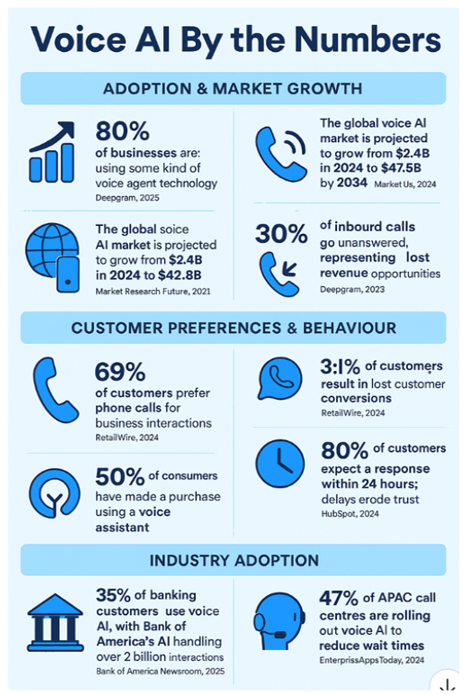
Voice AI by the Numbers — summarising adoption, customer preferences, and industry usage stats from the Synthflow whitepaper.
What does all this mean for CX leaders?
MaxContact’s survey found that 55% of people abandon calls due to long wait times, while 35% cite the agent’s lack of understanding. Complex account issues, payment negotiations, or emotional complaints are scenarios where empathy matters (and where automation often fails). The data reinforces what many CX leaders already sense: customers will accept AI for triage or routine tasks, but demand a human for anything nuanced.
Only 36% of respondents believe AI has improved their contact centre experience, and nearly 32% say it has made it worse. There’s a clear generational divide: 65% of 25-34 year-olds are comfortable with AI, but only 27% of over-55s feel the same. This generational lens is essential when planning AI and omnichannel strategies.
The core problem is bad AI, not AI itself. As noted in our earlier whitepaper, many AI deployments fail not due to technical limitations, but due to design and governance flaws. When AI is introduced without clear escalation paths, brand tone calibration, or decision traceability, customer confidence suffers. Mature solutions in the market now take a more human-aligned approach, creating AI agents that behave like brand-trained teammates, capable of recognising tone, understanding escalation logic, and respecting compliance frameworks.
Every decision should be traceable. Every transfer should carry context. These principles distinguish AI that scales from AI that stalls.
Omnichannel vs. Human-Centric: Getting the Balance Right
Consumers prefer voice support for immediate, emotionally resonant assistance. MaxContact’s research shows 60% view phone calls as the fastest route to resolution, far surpassing digital channels. Automation should manage repetitive tasks and noise, freeing up humans for high-value, high-empathy interactions. Smart triage, seamless handoffs, and transparent automation logic are crucial for omnichannel success.
Trust, Tone, and Transparency: Designing AI That Works
To address the most cited customer frustrations: poor escalation, limited response options, robotic tone – solutions must be designed with:
- Cultural and tone calibration
- Customisable escalation protocols
- Transparent audit trails
- Privacy-by-design aligned to GDPR and beyond
These aren’t technical ‘extras’, they are fundamental requirements in sectors where mistakes can harm trust, reputations, or wellbeing. In regulated or high-stakes categories such as healthcare, dating, or finance, the operational risk of misjudged automation is simply too high.
AI has advanced quickly, but trust remains fragile. Customers want efficiency, but not at the cost of clarity or empathy. The future of contact is digitally respectful, not just digital. The best AI solutions will pause, listen, and escalate when needed, not just answer fastest.
For contact centres navigating this balance in 2025, the opportunity lies in creating experiences that feel both seamless and human where AI takes the pressure off, but never takes over.
In our earlier whitepaper, we explored how AI adoption is reshaping customer contact – an area in which great risk and reward intersect. Six months on, the case for agentic AI has grown stronger, particularly in sensitive customer interactions where honesty and trust are essential.
Drawing on academic research and industry data, we now understand that AI can do more than just automate processes. It can unlock “more honest” conversations, especially in situations where fear of judgment by others or shame might inhibit disclosure.
This isn’t just a theory! Research from Stanford, MIT CSAIL, and NUS Business School reveals a striking trend: people are more open with AI than with human agents in contexts like mental health, financial distress, addiction, and relationship issues.
Why?
Because AI doesn’t judge.
Stanford calls this the social desirability bias, where people moderate their speech based on perceived perceptions. Removing this perception leads to greater honesty.
The ‘confession booth effect’, a term coined by NUS, also demonstrates this. In anonymised AI conversations, people admitted behaviours they hid from humans, like not reading terms and conditions or sharing passwords. In an insurance use case, initial disclosure accuracy rose by 40% when AI agents led the conversation.
MIT CSAIL found that people expend less mental energy managing impressions when talking to AI. This frees cognitive bandwidth for self-reflection and better problem-solving.
Now taking this approach, judgment-free AI agents can be implemented in high-trust, high-friction industries, such as mental health screening, legal triage, financial support, and trust & safety work. These artificial agents are more scalable and effective than humans.
The paradoxical truth is that people often feel more ‘heard’ by AI than by humans, because they don’t feel the need to pretend.
Yet traditional AI platforms struggle with emotional nuance, privacy, and secure escalation. It is essential to overcome these hurdles with strict compliance (GDPR+), contextual accuracy, and human-aligned escalation protocols.
The case for AI grows when combined with market data
Perhaps considered in the context of the long forecast demise of voice as a channel, recent research from the Synthflow white paper brings together a number of key usage stats which when considered with the findings of the academic research support the notion that AI voice will be here to stay?
What does all this mean for CX leaders?
- Trust is key. Sensitive topics require the psychological safety of customers to be part your AI solution.
- Design your AI agent around customer fears, not just FAQs.
- Measure resolution accuracy and emotional sentiment, not just AHT.
- Voice AI, when built correctly, can be the most honest channel for customers.
- Integrated agentic AI ensures a consistent experience across platforms.
Customers don’t need AI to sound human. They need AI to “feel safe”. The leading approach to agentic AI will redefine what honest, efficient, and compliant customer interactions can be – especially in a world in which truth drives trust, and trust drives revenue.
Organisations that have adopted AI in their contact centres have often seen significant improvements, such as halved response times, 40–70% operational cost reductions, and increased contact handling capacity. However, as some partners have noted in their recent engagements with members of the the CCP team, these gains can be followed by a flattening curve and then a performance dip, if not implemented correctly.
We have revisited our February 2025 whitepaper, ’2025: A Year of Difficult Conversations’, in which we explored how AI, automation, and digital transformation would drive new operational and ethical challenges in customer contact. We previously highlighted the tension between cost optimisation, customer experience, and why thoughtful project governance will be required.
We thought it would be good to consider what may have changed and what lessons should be revisited.
Six months of continued observation and implementation across the market have revealed risks that automation without the appropriate planning and controls can have on your future operating model are more nuanced. While short-term AI gains are impressive, traditional approaches may erode long-term value through burnout, agent attrition, and customer dissatisfaction. This is the ‘AI Paradox’: the risk that productivity gains today may fuel tomorrow’s operational decline.
Beneath the surface, a gradual yet detrimental erosion of the human layer is occurring. Collaborating with AI often leads to front-line staff experiencing reduced recovery time, increased complexity in remaining ‘manual’ queries, and escalating customer expectations. Without adjustments to team structure, support, or metrics, burnout becomes a growing threat.
This productivity half-life, a period where efficiency peaks and subsequently declines due to human strain, is no longer merely a theoretical risk. Businesses are starting to witness this AI-driven degradation in tangible figures: within 18 months of implementing traditional AI, attrition rates rise by 65%, customer satisfaction scores decline by 20-30%, and agent engagement scores fall concurrently as the technology matures.
Agentic AI presents a more sustainable alternative. Instead of perceiving AI as a replacement for human input, CCP’s partners are illustrating how task-completing AI agents can alleviate the burden on agents, facilitate judgment-free conversations, and ensure capacity for the most significant human interactions when needed. Consequently, it not only yields improved outcomes for customers but also contributes to enhanced retention, reduced training expenses, and a more resilient workforce.
Mitigating the AI Burnout Trap: Lessons from the Last Six Months
- Implement phased AI rollouts with human impact measures.
- Adopt agentic AI that empowers humans, preserving judgment for complex cases.
- Shift success metrics from AHT to FCR, CSAT, and agent engagement.
- Involve agents in AI workflow design and iteration.
- Regularly audit the AI-human balance: check whether tech amplifies or exhausts people?
- Track attrition, training costs, and productivity when calculating your ROI.
- Lead with transparency and ethics when deploying conversational automation.
Make certain you are on the right course
In short: if your AI roadmap doesn’t include agent wellbeing, then you’re building in risk. Efficiency must be sustainable, not just measurable.
Six months on, the market is beginning to learn this the hard way. The good news? There’s still time to course-correct. The AI paradox isn’t inevitable it’s just the result of decisions made without the full picture.
If you’d like to discuss in more detail how you can leverage the experience of our team and our partners, then feel free to contact us.
The health & wellbeing sector has always been rooted in human connection. Whether it’s supporting someone on their fitness journey, guiding a patient through treatment, or reassuring a customer about a sensitive health concern, the role of empathy is central.
But as the industry expands fuelled by digital-first healthtech, growing demand for wellness subscriptions, and rising consumer expectations, customer contact teams are under strain. The question for leaders is clear: how can we scale, stay compliant, and still deliver a deeply human experience?
From Cost Centre to Care Hub
Contact centres in health & wellbeing have traditionally been seen as a cost to control. Yet every conversation from a dietary query to a mental health support call has the potential to strengthen or weaken customer trust.
Forward-looking organisations are reframing service operations as a growth driver. For example, brands in this sector are exploring:
– Streamlined renewals and cancellations to reduce friction in subscription journeys.
– Smart routing for repeat callers, ensuring recurring issues are addressed quickly.
– Consistent omnichannel service so customers feel supported whether they call, chat, or message via an app.
When the contact centre is positioned as a core part of the brand experience, it moves beyond cost reduction and becomes a foundation for loyalty.
Automation with Empathy
The volume of routine contacts in this sector is significant – booking appointments, tracking deliveries, resetting passwords, updating payment details. These are tasks that can be handled by AI and digital workers, delivering instant, 24/7 responses.
The real opportunity is in blending automation with human empathy:
– Real-time agent assistance: AI surfaces the right knowledge at the right moment, helping advisors answer health or wellbeing queries accurately and sensitively.
– Vulnerability detection: AI can flag signs of distress in a caller’s tone or language, prompting the advisor to adapt their approach or escalate where appropriate.
– Conversation wrap-up & QA: Every interaction can be automatically summarised, with 100% of calls checked for compliance and quality, giving leaders confidence that standards are met consistently.
This partnership between people and technology doesn’t replace the human connection. It amplifies it, giving advisors the space to focus on empathy while automation handles repetitive, time-consuming tasks.
Scaling Securely & Sustainably
The growth in health & wellbeing services from digital fitness programmes to home diagnostics demands agile operating models. Customer demand can spike rapidly, whether during seasonal health peaks or major product launches.
To stay ahead, organisations are:
– Leveraging flexible sourcing models (nearshore, offshore, hybrid) to expand capacity quickly and cost-effectively.
– Adopting workforce management (WFM) tools to optimise scheduling and keep wait times short.
– Embedding compliance and security (PCI DSS, GDPR, sector-specific regulations) to ensure every interaction is safe and brand-protective.
By combining these capabilities, health & wellbeing brands can scale without losing sight of what matters most: trust, care, and the customer’s wellbeing journey.
The Strategic Shift Ahead
The contact centre is no longer just a helpdesk. It is becoming the front line of wellbeing experiences, where automation drives efficiency, and skilled advisors deliver empathy. For leaders in the sector, the challenge (and the opportunity) is to design operations that are both sustainable and human-centred.
At Customer Contact Panel, we connect organisations with over 220 delivery providers and 115 technology partners. We help health & wellbeing brands navigate their options, align technology with their customer journeys, and build resilient, customer-first operations fit for the decade ahead.
The promise of utilising AI in contact centres is enticing: faster service, lower costs, and increased productivity that pleases the CFO. Initially, the numbers support this claim. Efficiency increases by 30 to 55%, costs decrease, and there is the opportunity to scale without increasing headcount.
However, this success story hides a hidden threat that can quietly undermine every gain made.
It is the paradox at the heart of traditional AI implementations: the more you optimise for productivity, the faster you accelerate burnout.
If you’ve engaged them properly in your AI project, then at first agents will welcome the support. AI can take on routine admin, provide helpful prompts, and cut down on cognitive load, but as performance improves, expectations rise. The business begins to see these AI-powered gains as the new normal.
Over time, this creates a silent squeeze. Agents have less recovery time, more pressure, and fewer moments of meaningful human connection. Stress builds, job satisfaction falls, and staff turnover rises. It is suggested that within 12–24 months, many contact centres could face a reversal of their early gains.
This is the AI productivity half-life—a concept backed by both data and human psychology. Traditional AI shows impressive results in the first year, but by year two burnout sets in, staff turnover increases, training costs rise, CSAT drops and the contact centre enters a cycle of decline.
The numbers paint a sobering picture:
- Training new agents costs £15,000–£25,000 per head
- AI systems degrade when experienced agents leave
- Customer loyalty falls when interactions lose their human touch
Ironically, the very systems designed to enhance performance can end up eroding it, because the human layer was never fully accounted for.
So, what is the alternative?
The better agentic AI solutions that we are now seeing take a fundamentally different approach. It’s not about replacing humans, it’s about augmenting them in sustainable, psychologically informed ways.
The AI agents don’t just answer questions; they complete tasks, make decisions, and manage workflows. They take pressure off humans without cutting them out.
And the results?
- Better job satisfaction
- Longer-lasting productivity
- Reduced turnover
- Stronger customer outcomes
More importantly, these systems are designed with long-term ROI in mind, not just how efficient your contact centre is today but how sustainable it will be two or three years from now.
How to Mitigate the AI Burnout Trap
- Develop an agentic AI that reduces workload without diminishing human agency.
- Shift KPIs beyond AHT to include FCR, CSAT, and engagement scores.
- Implement phased rollouts to monitor human impact before scaling.
- Prioritise agent training and involvement in AI design and deployment.
- Track agent wellbeing alongside operational performance.
- Combine automation with empowerment, ensuring humans retain control over complex and meaningful tasks.
- Regularly audit AI value, evaluating cost, sustainability, and satisfaction.
This Location Watch was prepared with valuable contributions from Temo Magradze, Founding Partner of Evolvexe BPO, as well as Davit Tavlalashvili, Head of the Investment Department, and Ketevan Kanashvili, Senior Investment Relations Manager at Enterprise Georgia. It also draws on research and insights from Ryan Strategic Advisory, specifically the report “2025 CX Technology and Global Services Survey”. Their perspectives on the evolution of Georgia’s outsourcing industry are especially insightful in highlighting why the country is gaining attention from UK, EU and North American companies as a nearshore and offshore delivery hub.
Georgia is rapidly gaining recognition as a promising BPO destination, thanks to its modern infrastructure, strategic government support, and a clear ambition to grow within the global outsourcing ecosystem. The recent BPO Leaders Summit 2025 in Tbilisi, hosted by Enterprise Georgia and Ryan Strategic Advisory, brought together industry experts, investors and government officials who confirmed the country’s strong potential.
1. Outsourcing Popularity & Market Positioning
As Temo Magradze emphasises, Georgia’s outsourcing industry has grown significantly in recent years. Its appeal lies in affordability, a highly skilled workforce, and a government eager to attract investment. Positioned at the crossroads of Europe and Asia, Georgia combines geographic advantage with a dynamic, pro-business climate, making it an increasingly popular hub for European operations.
According to the Ryan Strategic Advisory – 2025 CX Technology and Global Services Survey (see screenshot), Georgia scores 2.8, placing it slightly below mid-tier in offshore favorability. Yet, several countries ranked lower continue to be regarded as more mature outsourcing destinations due to their established ecosystems and long-standing track records:

- Turkey (2.6) – Longstanding BPO hub with strong multilingual capabilities, particularly in European market support.
- Colombia (2.7) – A leading nearshore delivery market for North America, well known for Spanish-English bilingual services.
- Nigeria (2.7) – Growing rapidly in scale with an established IT-enabled services sector and a deep labor pool.
- Slovenia (2.7) and Bulgaria (2.7) – Both EU member states with recognized nearshore outsourcing reputations, especially in IT, finance, and multilingual service delivery.
Although these markets rank lower than Georgia in the 2025 survey, they are considered more mature thanks to their larger delivery ecosystems, deeper outsourcing experience, and stronger global visibility. The fact that Georgia now scores ahead of such established players underlines its growing credibility and demonstrates how it is winning favorable attention against locations traditionally chosen for offshore and nearshore outsourcing.
2. Cost Competitiveness & Commercial Advantage
Labour and operational costs in Georgia are 40–50% lower than in established Central and Eastern European hubs such as Poland. Average salaries for customer service roles remain in the £456–£608 range, while programmers earn around £1,140 monthly.
One of Georgia’s strongest incentives is its International Company Status, which grants significant tax advantages, including reduced corporate tax rates. Coupled with government-backed grants and subsidies, this positions Georgia as one of the most cost-efficient outsourcing environments in the region.
3. Workforce, Language Skills & Talent Pool
Georgia boasts a multilingual workforce fluent in English, German, Russian and other European languages. Deloitte research estimates over 500,000 multilingual professionals across major cities. The most common roles include customer support, IT helpdesks, finance and accounting, and software development.
Universities and vocational institutes actively integrate English and technical training. Georgia’s education system, including institutions such as Kutaisi International University (developed with Germany’s Technical University of Munich), is producing a steady pipeline of outsourcing-ready professionals, many of whom are multilingual and STEM-focused.
4. Time Zone, Accessibility & Nearshoring Appeal
Situated in the UTC+4 time zone, Georgia overlaps conveniently with European working hours, while also complementing North American operations by enabling round-the-clock coverage.
Infrastructure for travel and remote collaboration is strong: Tbilisi, Kutaisi and Batumi airports all provide direct flights to key European hubs. This accessibility allows easy site visits and integration with international teams.
5. Infrastructure & BPO Ecosystem
Georgia has invested heavily in digital infrastructure, with 97% broadband coverage and widespread 4G/5G access. Tbilisi remains the primary outsourcing hub, but as Temo highlighted to me, there is rapid growth of secondary cities. For example, Evolvexe recently launched a major tech support project with ASUS from Kutaisi, servicing Germany, Switzerland and Austria. Batumi is also attracting investment and fast becoming a secondary BPO location.
6. Government Support & Incentives
The government, through Enterprise Georgia, plays a pivotal role in supporting BPO expansion. Simplified business registration (often completed in a single day), tax incentives, and subsidies for training make it easier for foreign companies to establish operations. While GITA focuses on supporting IT infrastructure and the ICT Association concentrates on IT-related initiatives rather than BPO specifically, these organisations contribute to the broader tech ecosystem that benefits the sector.
Industry associations, such as the ICT Association, also provide a strong bridge between policy-makers and BPO operators, ensuring that the sector’s needs are addressed. Tavlalashvili and Kanashvili stress that this alignment of public and private stakeholders has been critical to the sector’s momentum.
7. Industry Success Stories
Georgia is already home to a mix of international and local players. Companies such as Making Science Sweeft (software development) and Evolvexe Outsourcing (customer support and tech services) demonstrate the ability of Georgian firms to deliver value across Europe and North America. Majorel, Concentrix, EPAM Systems and Viber have also scaled their operations in Georgia, validating the country’s growing importance on the global outsourcing map.
8. Cultural Fit & Service Excellence
Georgians are often described as the “first Europeans”, with a cultural heritage rooted in hospitality, loyalty and respect for education. This translates into a natural customer-service orientation, where tone, empathy and relationship-building come naturally. This cultural foundation gives Georgian agents an edge in handling sensitive, customer-facing interactions with empathy and professionalism.
9. Innovation, Growth & Future Trends
Georgia is moving beyond traditional call centres into higher-value areas such as software development, fintech, AI-enabled services and digital operations. With IT exports surpassing $1 billion in 2024, the country is positioning itself as not only a cost-effective outsourcing hub but also a source of innovation and digital transformation expertise.
Looking ahead, Temo Magradze predicts that in the next three to five years, Georgia will transition from being primarily a low-cost option to a recognised hub for quality-driven, technology-enabled outsourcing, while still maintaining a commercial edge over EU and US markets.
Final Thoughts
Georgia is establishing itself as one of the most dynamic emerging BPO destinations in Europe. Its multilingual workforce, strong government backing, cost advantages and expanding digital ecosystem make it an attractive nearshore and offshore option for companies across the UK, EU and North America.
As Magradze, Tavlalashvili and Kanashvili each highlight, the country’s unique blend of hospitality-driven service culture and tech-driven innovation gives Georgia a competitive edge. While the sector is still developing compared with more mature hubs, Georgia’s momentum is undeniable, positioning it as a location to watch very closely in the years ahead.
Want to find out more or meet vetted providers in Georgia? Drop us a line, we’re happy to help you explore your options.
Of all the contact centre use cases for AI, Pure Voice AI is the most disruptive – and potentially the most transformative. Unlike Agent Assist or auto-wrap that augment human performance, Pure Voice AI replaces the agent entirely for certain interactions.
What is the AI doing in Pure Voice AI?
Pure Voice AI uses fully autonomous AI agents capable of holding spoken conversations with customers—with no human agent in the conversation. For an inbound call, the AI could triage the call, and if it can deal with the interaction itself, it doesn’t need to trouble a human agent. If the enquiry does need a human agent, it can monitor who’s available and route the call to the next best available agent.
Ultimately, the idea is that these AI agents can answer questions, resolve issues, and even handle sensitive interactions such as payment disputes or appointment scheduling.
It’s far more sophisticated than IVR (interactive voice response) trees or chatbots. Pure Voice AI uses advanced natural language understanding, real-time decisioning, and speech synthesis to hold dynamic, human-like conversations.
Key benefits: 24/7 service
The benefits case here is far less about cost reductions, agent productivity gains and optimisations, as use cases 1-6 have already delivered well here.
It is far more about providing round the clock service and enhancing brand experience. Because we all have lives, and work, that mean calling between set hours can sometimes be difficult. But the reason many contact centres are not 24/7 with human agents is because the business case of the cost and overheads – from staff costs to heating and lighting – doesn’t stack up.
Smoothing demand
Not only is calling at set times difficult, it creates spikes in demand, for example around lunch time or just after work. What’s more, pro-active outbound calls can also be scheduled for more customer friendly times of day.
Multi-lingual cover
Where a contact centre needs to serve multiple languages, there is typically a primary language that most human agents speak, with a handful of specialists available for secondary languages. Which means that those secondary languages are a scarce resource, both in terms of availability and recruitment. With Pure Voice AI in the mix, it can detect the language being spoken and switch seamlessly into it.
Implementation considerations
While everyone is trying to rush to this use case, without computer use, proper integrations, optimised and redesigned processes, there is no real opportunity to leap-frog to full voice AI. Because the foundations are simply not in place to support it.
What can we expect to see?
While not quite there yet, it is just around the corner, and there will undoubtedly be a proliferation of pure voice AI, especially for outbound. Though businesses should expect regulation to swiftly follow.
As we await the true potential of Pure Voice AI, it is a case of charting a path to how you achieve this in future, not the focus for today. Down that road lies complexity, risk and far greater likelihood of project failure. When you could be realising value right now and incrementally from use cases that build the maturity on which to develop pure voice AI. A far safer path to value on every front.
To find out more about how CCP can help you make the right technology choices, read more here or get in touch.
This series of articles is drawn from our webinar with Jimmy Hosang, CEO and co-founder at Mojo CX. We explored seven key use cases for AI in contact centres, starting from the easiest productivity gains to value generating applications. You can find a summary of all seven use cases here, or watch the webinar in full here.
Agents often juggle multiple tasks during customer interactions, from information retrieval across systems, to research perhaps through search engines, and data entry to note-taking in CRMs and/or admin systems. Not to mention holding a conversation where they are listening and responding as naturally as possible. It’s a lot to ask while also ‘being present’ with the customer. The opportunity for errors and a sub-par conversation is obvious.
AI-driven hands-free conversations are designed to remove everything other than the conversation from the agent’s to do list.
What is the AI doing in Hands-free Conversations?
This again builds on the previous use cases as a good starting point. Think right back to use case 1 – autowrap, where the AI summarises call notes, and can either simply be copied and pasted into the CRM by the agent, or automated through deep integrations.
Imagine then a world, where not only does the AI do this, but it also navigates you though CRM screens as well as other platforms and apps, retrieving customer records and auto-populating information as you go. Meanwhile use case 5 – agent assist, is popping up with useful prompts to guide the call. Science fiction? Or science fact. The reality is that this is a genuine use case of today.
Key Benefits of Hands-Free Conversations: Absolute focus on the call
A truly liberating experience, the agent is focused solely on their conversation with the customer, while being fed the information they need to support the call and without worrying about what they are capturing as the AI is listening and interpreting to do that on their behalf.
The agent can listen intently, truly process the query and be mentally available to deliver responses where they’ve had the headspace to consider its appropriateness and the style of their delivery. Placing the human interaction at the very centre of the call to the exclusion of all other noise is extremely valuable when it comes to resolving that customer’s needs.
Reduced time spent on admin
If you were to say 10-20% of an agent’s time on a call is just typing and clicking to enter information and navigate screens, while a slightly arbitrary number, it’s inevitably slowing the call and reducing its value to the customer as the agent fills to give themselves the time to type.
Reduced keying errors
As the AI takes care of data entry, there are fewer agent keying errors. Not only does this reduce time on corrections, assuming there are field validations in place, or time taken to later interpret poorly captured data, it improves data quality overall. A key requirement for better analysis, better AI, better compliance, and better future performance.
Improved accessibility
What’s more, hands-free conversations can enhance accessibility – acting as a reasonable adjustment for people with visual impairments or limited hand function.
Implementation Considerations
First, the deep integrations necessary to support hands free integrations take time and shouldn’t be underestimated. Which is in part why this is use case 6 of 7. Because there will need to be some AI maturity building already to ensure both support for and success for this use case. But assuming you have that, it’s a natural progression to freeing agents simply to support customers.
However, there is another school of thought. Where the AI simply deals with all of the legacy for you. Which means you simply live with the poor processes, old mainframe systems, disparate add-ons and Excel spreadsheets you currently have, but without having to interact with them. The savings of not dealing with those, and not having to learn complex keying procedures to get to the screen you want, would be phenomenal and free cash for investment elsewhere. Listen from around 45 minutes into the webinar for Jimmy’s slightly mind-blowing hot take.
Second, accuracy and model training is paramount, which means training and testing the models will also take time and effort. As with other use cases, you will need to develop your own views of what is acceptable
Third, while it sounds all-encompassing, you could consider running the trained model locally and therefore reduce the computational costs.
Measuring Success
The primary KPIs here sit in customer satisfaction, agent productivity/average handling time and data entry or processing error rates. Beyond those, agent job satisfaction can be measured through feedback, attrition rates, etc.
But by far the most interesting benefit is the absolute focus on the customer and the delivery of superior service that should translate through to customer lifetime value.
To find out more about how CCP can help you make the right technology choices, read more here or get in touch.
This series of articles is drawn from our webinar with Jimmy Hosang, CEO and co-founder at Mojo CX. We explored seven key use cases for AI in contact centres, starting from the easiest productivity gains to value generating applications. You can find a summary of all seven use cases here, or watch the webinar in full here.