
For much of the last decade, customer experience investment was driven by a relatively simple argument. Better experiences create better outcomes. Today, that argument is no longer enough.
Customer Contact Panel sponsored research by Ryan Strategic Advisory through the 2026 CX Technology and Global Services Survey to explore a challenge we encounter regularly: what gives organisations the confidence to approve investment in customer operations transformation? We asked 815 enterprise executives what forms of external support would help them make faster and more confident decisions regarding contact centre technology, outsourcing and operational change.
The answer was remarkably clear. Proof. Business case and ROI modelling ranked as the single most important factor. Independent views on technology options, trade-offs and proven outcomes ranked immediately behind. Delivery model design also emerged as a major consideration.
Taken together, the findings reveal a significant shift in how organisations evaluate CX investments. Decision makers are no longer looking for promises. They are looking for evidence.
This reflects the environment many organisations now operate within. Budgets remain under pressure. Technology options continue to multiply. AI vendors are making increasingly ambitious claims. Outsourcing models are evolving. The number of potential solutions available to contact centre leaders has never been greater.
Ironically, more choice has made decision making harder. The challenge facing many organisations is not a shortage of opportunities. It is a shortage of confidence.
Can the supplier deliver? Will the technology work? How long will implementation take? What risks need to be managed? Most importantly, what return will the organisation receive in exchange for its investment?
The survey suggests that organisations increasingly want independent validation before committing to major decisions. This explains why advisory support, benchmarking, decision validation and technology assessment all scored strongly among respondents.
Executives are seeking reassurance that the choices they make are grounded in proven outcomes rather than marketing claims.
This has important implications for suppliers and internal transformation teams alike. Features are no longer enough. Capabilities are no longer enough. Even successful case studies may not be enough.
Organisations want to understand how a proposed solution will perform in their environment, against their objectives and within their commercial constraints.
That requires a different conversation. One focused less on products and more on outcomes. Less on innovation and more on implementation. Less on possibility and more on proof.
Perhaps the most significant finding from the survey is that decision making itself is becoming a competitive advantage. The organisations moving fastest are not necessarily those with the largest budgets or the newest technology.
They are the organisations that can build confidence, align stakeholders and create a credible business case for change.
In a market full of options, confidence may be the most valuable asset of all. And confidence starts with proving the ROI.
Catch up on the series by reading Why CFOs Hold the Key to CX Transformation here, followed by Who Really Drives CX Change? here.
Most customer experience transformation programmes begin with an assumption.
If the business wants to improve customer outcomes, the people responsible for customer experience will naturally drive change.
The reality appears more complicated.
As part of the 2026 CX Technology and Global Services Survey by Ryan Strategic Advisory, Customer Contact Panel sponsored research into a question we regularly encounter when supporting customer operations transformation programmes: who actually drives change inside large organisations? The results highlight a clear distinction between the executives who champion transformation and those who are more likely to support it once a direction has already been agreed.
When asked which board-level stakeholders are most likely to drive customer operations transformation, respondents consistently pointed towards CEOs, Managing Directors, Chief Operating Officers and Chief Customer Officers.
In fact, nearly seven in ten respondents identified CEOs as either enablers or strong enablers of change.
The Chief Customer Officer and Chief Marketing Officer scored even higher when it came to strong enabling influence.
These findings reinforce an important truth.
Successful CX transformation is rarely a technology initiative. It is usually a business initiative.
The strongest advocates for change tend to be leaders who are accountable for growth, competitiveness, customer retention or operational performance.
However, some of the survey’s most interesting findings relate to the roles that were notably absent from the list of major change drivers.
Chief People Officers and HR leaders were among the least likely to be identified as strong enablers.
Transformation Directors and Solutions Leaders performed better, but not as strongly as many might expect given that transformation is often their primary responsibility.
Even Chief Technology Officers were more likely to be viewed as enablers than strong enablers.
Why does this matter?
Because many organisations continue to position transformation projects around technology implementation rather than business outcomes.
Technology teams help make change possible.
Transformation teams help coordinate delivery.
But the survey suggests that the initial momentum often comes from commercial and operational leadership.
The leaders driving change are those closest to customer outcomes, growth targets and operational performance metrics.
For CX leaders seeking support for a new initiative, there is an important lesson.
The first challenge is not selecting the right solution.
The first challenge is building the right coalition.
Understanding who naturally supports change, who remains neutral and who may resist investment can dramatically improve the chances of success.
Many transformation programmes fail before they begin because they focus on technology selection before stakeholder alignment.
The data suggests the reverse approach may be more effective.
Get the right people around the table first.
Then decide what to do next.
If you missed the first article, Why CFOs Hold the Key to CX Transformation , you can read it here. Then continue to the third article, Show Me the ROI: What CX Leaders Need to Prove, here.
For years, the customer experience industry has focused on technology.
CRM, AI, automation, analytics, cloud migration and workforce optimisation have dominated conference agendas and boardroom discussions. Yet despite the growing number of available solutions, many organisations still struggle to move forward with meaningful change.
New research from the 2026 CX Technology and Global Services Survey suggests the problem may not be technology at all.
Customer Contact Panel sponsored a series of questions within the survey by Ryan Strategic Advisory, gathering the views of 815 enterprise executives responsible for strategic contact centre decisions across North America, Europe and Asia-Pacific. The findings reveal a striking pattern.
When respondents were asked which board-level stakeholders are most likely to drive or block change in contact centre operations, one role stood out above all others.
The CFO.
Forty percent of respondents identified the CFO or Finance Director as either a blocker or extreme blocker to customer experience investment decisions. No other executive role attracted a higher level of resistance. Meanwhile, only 36% viewed finance leaders as enablers or strong enablers.
That creates a significant challenge for anyone attempting to introduce new technology, redesign an operating model, or secure investment in customer service transformation.
The findings are not necessarily a criticism of finance leaders. In many organisations, the CFO is fulfilling exactly the role they are expected to play.
Their responsibility is not to champion innovation. Their responsibility is to protect capital allocation and ensure investments generate measurable returns.
The issue is that many CX initiatives are still presented in terms that finance teams struggle to validate.
Better experiences.
Improved customer journeys.
Reduced effort.
Greater engagement.
All worthwhile objectives, but often difficult to translate into financial outcomes.
The survey’s second question helps explain why this matters.
Respondents were asked what external support would help them make faster, more confident decisions around contact centre investment. The clear winner was business case and ROI modelling.
More than four out of five respondents rated ROI modelling as having either high or critical impact on decision making.
The message is straightforward.
Most CX leaders spend time trying to convince stakeholders that change is necessary. The data suggests they should spend more time proving that change is financially justified.
The organisations making progress are not necessarily those with the best technology.
They are the organisations that can clearly demonstrate the commercial impact of change.
If finance is holding the purse strings, then finance needs evidence.
The future of CX transformation may depend less on the quality of the solution and more on the quality of the business case behind it.
Continue the series by reading Who Really Drives CX Change? here, followed by Show Me the ROI: What CX Leaders Need to Prove here.
Optimising Sales in the B2C Contact Centre: Designing Better Conversations at Scale
For many consumer-facing organisations, the contact centre is one of the most commercially influential parts of the business, yet it is often optimised narrowly around volume and speed. Conversion targets and short-term performance metrics can dominate, while the quality of the customer experience becomes secondary.
The strongest B2C sales operations take a different approach. They focus less on pressure and more on creating the conditions for confident decision-making. As self-service, digital channels, and automation absorb simpler transactions, the conversations that reach agents are more complex and emotionally charged. Customers are not just buying; they are seeking reassurance. Agents need strong product knowledge, empathy, and the ability to adapt in real time. Training must therefore move beyond scripts and compliance to emphasise judgment, listening, and consultative skills.
What organisations choose to measure shapes behaviour. B2C sales environments that balance conversion and revenue metrics with quality, customer outcomes, and long-term value tend to perform more sustainably. Narrow KPIs drive narrow behaviours, while balanced measures support richer, more productive conversations.
CRM platforms, analytics, and automation should provide agents with context, customer history, and next-best actions quickly and intuitively. When systems reduce friction, agents can focus on the customer rather than navigating tools. Not every contact represents the same opportunity, so aligning propositions to customer intent improves conversion while protecting the customer experience. Regular call listening, targeted feedback, and incentives that reward quality outcomes help teams improve consistently without increasing burnout.
In B2C environments, optimising sales is not about doing more with less. It is about designing better conversations at scale.
Optimising Sales in the B2B Contact Centre: From Lead Handling to Revenue Enablement
In B2B organisations, contact centre sales activity is often undervalued. It is sometimes seen as tactical support rather than a strategic contributor to revenue. Yet when designed effectively, the contact centre can play a critical role in pipeline creation, opportunity progression, and account growth. Unlike B2C, B2B sales conversations are rarely about immediate conversion. They are about qualification, insight, and orchestration across longer buying cycles.
B2B agents need a clear understanding of ideal customer profiles, buying signals, and sector context. Conversations are consultative by nature, requiring confidence, commercial awareness, and the ability to progress opportunities rather than simply pass them on. Integration between the contact centre, CRM, and wider sales teams is essential. Clear ownership of stages, structured handovers, and shared visibility of the pipeline prevent leads from stalling or being lost between channels.
Success is less about call volumes and more about quality indicators such as qualification accuracy, pipeline contribution, progression to the next stage, and account value over time. When metrics reflect this reality, behaviour follows. CRM systems, data enrichment, and analytics should support agents in identifying intent, capturing insight, and triggering next steps efficiently. The goal is not speed, but relevance. Ensuring consistency of qualification and messaging across teams remains critical. Small improvements in conversation quality can have a significant downstream impact on revenue.
When aligned correctly, the contact centre becomes an extension of the B2B sales function, improving coverage, responsiveness, and commercial discipline. Optimising B2B contact centre sales is not about closing faster. It is about enabling better decisions at every stage of the buying journey.
Whether your organisation operates in B2C or B2B markets, Customer Contact Panel (CCP) can help you source the right sales specialists to strengthen your contact centre operations.
Contact us today: hello@customercontactpanel.com
AI has amplified all of this. What was already a complex technology landscape is now louder, faster, more confident in its promises and far less easy to rationally assess.
The result is a familiar pattern. Reams of content. Lots of conversations. Plenty of demos. Very few decisions.
“The problem isn’t a lack of technology. It’s a lack of confidence about where to start.”
Too much choice, not enough direction
Most contact centre leaders are exposed to hundreds of tools, platforms and propositions. CCaaS, Automation, AI, Analytics, Workforce optimisation, Knowledge, Quality, Speech, Sentiment, and/or Real-time coaching.
Each promises transformation, yet few explain sequencing or iterative value.
Technology discussions often jump straight to an end state. Fully automated journeys. AI-first contact centres. Single platforms doing everything. The reality is that most organisations are not starting from a clean slate. They are operating with legacy systems, ingrained processes and teams who are already stretched.
When leaders are presented with change at scale, hesitation is a rational response.
“Indecision is rarely caused by resistance to change. It’s caused by unclear risk.”
One ecosystem, many perspectives
One of the most common mistakes we see is treating contact centre technology as a single audience decision. In reality, it is experienced very differently depending on where you sit.
Customers experience outcomes – Resolution, speed, effort.
Agents experience tools – Screens, prompts, workflows, knowledge.
Team Leaders experience data – Performance metrics, quality scores, coaching demands.
Executives experience cost, compliance, risk and return.
Technology fails when these perspectives are treated in isolation. A tool that improves reporting but makes life harder for agents will not deliver sustainable value. Automation that reduces contacts, but damages trust will quickly be rolled back.
“Technology only works when data flows through the organisation, not when it stops at functional boundaries.”
Why replacing everything may not always work
There is a temptation to believe that the answer is replacement. New platform. New vendor. Clean start.
Sometimes that is necessary. Often it is not. Make sure you have clarity as to what you need to achieve and the capability of the solution you are looking at as large-scale CCaaS or platform replacement is expensive, disruptive and can be slow. It introduces delivery risk at exactly the moment many organisations are under pressure to stabilise performance. It also assumes that the underlying processes are already fit for automation, which is rarely the case.
Some organisations have truly exhausted their tech ecosystem’s capabilities and potential.
But many organisations do not need everything at once, they need progress.
That is why we increasingly see value created through targeted, point-solution adoption. Technology that does one job well and (crucially) integrates into the existing environment.
“Momentum is more valuable than perfection.”
Starting where impact is visible
One of the most effective starting points we see for technology change is quality management.
Historically, quality assurance has been constrained by sampling. A handful of interactions reviewed each month, representing a fraction of actual customer conversations. Coaching is based on partial insight. Risk is often identified after the event.
Automation changes that dynamic. Moving from fractional sampling to full visibility unlocks far more than compliance. It enables better coaching, faster identification of issues, clearer insight into customer sentiment and more consistent experiences.
Importantly, this type of AI does not remove people from the process. It supports them.
- Agents receive clearer feedback.
- Team leaders focus on coaching rather than administration.
- Leaders gain confidence in what is happening across the operation
“AI delivers value fastest when it helps people do their jobs better, not when it tries to replace them.”
What good looks like now
The most effective contact centre leaders we work with are not chasing the biggest transformation story.
They are making deliberate choices.
They prioritise problems before platforms.
They sequence change rather than attempting to do everything at once.
They invest in technology that supports people and process, not just cost reduction.
They accept that doing nothing is still a decision, and often the riskiest one.
Technology will continue to evolve. AI will become more capable. Customer expectations will continue to rise. The organisations that succeed will be those that move with intent rather than waiting for certainty.
“The most effective contact centres are not the most automated. They are the most deliberate.”
Much of the conversation about the future of customer contact is dominated by technology.
AI. Automation. Analytics. Bots. Faster. Cheaper. Smarter.
Yet when we step back and look honestly at where organisations are struggling, the challenge is rarely technology-first. It is people-first.
Most businesses already know what needs to change. The harder truth is that knowing does not reliably translate into doing. Strategy decks are written, tools are procured, pilots are launched – and still the outcomes lag behind ambition.
That execution gap sits squarely in the people layer.
The Gap Between Knowing and Doing
Across sectors, the pattern is remarkably consistent. Leaders understand that customer expectations are rising, that work is becoming more complex, and that traditional operating models are under strain. Teams on the ground feel it every day.
And yet progress often stalls.
This is not because organisations lack capability or intent. It is because many are still trying to solve today’s problems with yesterday’s assumptions. Training models remain largely ‘one and done’. Roles have evolved faster than the support structures around them. Managers are asked to lead a more complex, emotionally demanding workforce while being measured on metrics designed for a simpler world.
Holding the line on those legacy measures creates lagging outcomes – first for employees, and then inevitably for customers.
Future Fit organisations recognise that execution failure is rarely a technology issue. It is a people issue, reinforced by culture, incentives, and leadership capability.
The Agent Role Has Already Changed
The frontline role in customer contact is no longer primarily transactional.
Routine interactions are increasingly handled through automation, self-service, or deflection. What remains with humans is more demanding:
- Edge cases that fall outside standard rules
- Emotionally charged conversations
- Complex judgement calls
- Moments where reassurance, interpretation and empathy matter most
Yet many organisations are still hiring, training and measuring agents as if the job has not fundamentally changed.
Future Fit thinking starts with a simple acknowledgement:
the agents we need now – and in the future – are different.
They need stronger judgement, emotional intelligence, and confidence navigating ambiguity. They also carry a higher emotional load, often in remote or hybrid environments where informal support and loyalty are harder to build.
If we do not redesign roles, support, and leadership around this reality, burnout becomes structural rather than incidental.
AI’s Role: Reducing Friction, Not Replacing Humans
In a Future Fit model, AI is not the solution. It give the power to unlock it.
Used well, AI should make work more human, not less. That means:
- Removing friction from the agent day
- Reducing cognitive load
- Surfacing the right knowledge at the right moment
- Guiding decisions without dictating them
- Supporting judgement rather than automating it away
This requires intentional design. Clear purpose for each use case. Strong guardrails around how data and insight are used. Ongoing development rather than ‘set and forget’.
Crucially, it also requires honesty with employees. When AI is positioned as something being done to people, resistance is inevitable. When it is designed and communicated as something done for them, adoption follows. Ideally, it should be co-created with employees – let them see their fingerprints all over the final solution.
Future Fit organisations understand that AI does not remove responsibility from leaders. It increases it.
Metrics will set the mindset of employees – they send the message about what matters most. And these mindsets shape behaviour.
Culture Follows Metrics
One of the most common failure points in transformation is misalignment.
Technology changes. Roles change. Customer expectations change.
But metrics stay the same and still the investment in people lags.
Future Fit organisations are ruthless about asking:
- Do our measures reflect the work we actually want people to do?
- Are managers incentivised to enable value, or simply control volume?
- Are we measuring activity, or outcomes?
As technology takes care of the repeatable, human value becomes the differentiator. That demands new definitions of productivity, stronger coaching capability, and leadership that understands how to create space for quality, not just speed.
Culture does not shift through slogans. It shifts through what is rewarded, tolerated, and prioritised.
From Transformation Programmes to Continuous Evolution
There is no finish line.
Future Fit organisations do not treat change as a programme with an end date.
They treat it as ongoing evolution:
- Continuous improvement rather than big-bang transformation
- Listening deeply to employees as well as customers
- Taking analytics upstream to fix root causes, not mask symptoms
- Investing in leadership capability alongside platforms and tooling
They also recognise a hard truth: AI can paper over cracks — or expose them. The difference lies in whether organisations are willing to look honestly at how work is really done.
The Question That Really Matters
Future Fit is not about asking, “What technology should we buy?”
It is about asking:
- Why do customers come to us?
- Why do they stay?
- What do our people need to deliver on that promise – today and tomorrow?
Get the people element right, and process and technology fall into place.
Get it wrong, and no amount of AI will save you.
Organisations that have adopted AI in their contact centres have often seen significant improvements, such as halved response times, 40–70% operational cost reductions, and increased contact handling capacity. However, as some partners have noted in their recent engagements with members of the the CCP team, these gains can be followed by a flattening curve and then a performance dip, if not implemented correctly.
We have revisited our February 2025 whitepaper, ’2025: A Year of Difficult Conversations’, in which we explored how AI, automation, and digital transformation would drive new operational and ethical challenges in customer contact. We previously highlighted the tension between cost optimisation, customer experience, and why thoughtful project governance will be required.
We thought it would be good to consider what may have changed and what lessons should be revisited.
Six months of continued observation and implementation across the market have revealed risks that automation without the appropriate planning and controls can have on your future operating model are more nuanced. While short-term AI gains are impressive, traditional approaches may erode long-term value through burnout, agent attrition, and customer dissatisfaction. This is the ‘AI Paradox’: the risk that productivity gains today may fuel tomorrow’s operational decline.
Beneath the surface, a gradual yet detrimental erosion of the human layer is occurring. Collaborating with AI often leads to front-line staff experiencing reduced recovery time, increased complexity in remaining ‘manual’ queries, and escalating customer expectations. Without adjustments to team structure, support, or metrics, burnout becomes a growing threat.
This productivity half-life, a period where efficiency peaks and subsequently declines due to human strain, is no longer merely a theoretical risk. Businesses are starting to witness this AI-driven degradation in tangible figures: within 18 months of implementing traditional AI, attrition rates rise by 65%, customer satisfaction scores decline by 20-30%, and agent engagement scores fall concurrently as the technology matures.
Agentic AI presents a more sustainable alternative. Instead of perceiving AI as a replacement for human input, CCP’s partners are illustrating how task-completing AI agents can alleviate the burden on agents, facilitate judgment-free conversations, and ensure capacity for the most significant human interactions when needed. Consequently, it not only yields improved outcomes for customers but also contributes to enhanced retention, reduced training expenses, and a more resilient workforce.
Mitigating the AI Burnout Trap: Lessons from the Last Six Months
- Implement phased AI rollouts with human impact measures.
- Adopt agentic AI that empowers humans, preserving judgment for complex cases.
- Shift success metrics from AHT to FCR, CSAT, and agent engagement.
- Involve agents in AI workflow design and iteration.
- Regularly audit the AI-human balance: check whether tech amplifies or exhausts people?
- Track attrition, training costs, and productivity when calculating your ROI.
- Lead with transparency and ethics when deploying conversational automation.
Make certain you are on the right course
In short: if your AI roadmap doesn’t include agent wellbeing, then you’re building in risk. Efficiency must be sustainable, not just measurable.
Six months on, the market is beginning to learn this the hard way. The good news? There’s still time to course-correct. The AI paradox isn’t inevitable it’s just the result of decisions made without the full picture.
If you’d like to discuss in more detail how you can leverage the experience of our team and our partners, then feel free to contact us.
Agents often juggle multiple tasks during customer interactions, from information retrieval across systems, to research perhaps through search engines, and data entry to note-taking in CRMs and/or admin systems. Not to mention holding a conversation where they are listening and responding as naturally as possible. It’s a lot to ask while also ‘being present’ with the customer. The opportunity for errors and a sub-par conversation is obvious.
AI-driven hands-free conversations are designed to remove everything other than the conversation from the agent’s to do list.
What is the AI doing in Hands-free Conversations?
This again builds on the previous use cases as a good starting point. Think right back to use case 1 – autowrap, where the AI summarises call notes, and can either simply be copied and pasted into the CRM by the agent, or automated through deep integrations.
Imagine then a world, where not only does the AI do this, but it also navigates you though CRM screens as well as other platforms and apps, retrieving customer records and auto-populating information as you go. Meanwhile use case 5 – agent assist, is popping up with useful prompts to guide the call. Science fiction? Or science fact. The reality is that this is a genuine use case of today.
Key Benefits of Hands-Free Conversations: Absolute focus on the call
A truly liberating experience, the agent is focused solely on their conversation with the customer, while being fed the information they need to support the call and without worrying about what they are capturing as the AI is listening and interpreting to do that on their behalf.
The agent can listen intently, truly process the query and be mentally available to deliver responses where they’ve had the headspace to consider its appropriateness and the style of their delivery. Placing the human interaction at the very centre of the call to the exclusion of all other noise is extremely valuable when it comes to resolving that customer’s needs.
Reduced time spent on admin
If you were to say 10-20% of an agent’s time on a call is just typing and clicking to enter information and navigate screens, while a slightly arbitrary number, it’s inevitably slowing the call and reducing its value to the customer as the agent fills to give themselves the time to type.
Reduced keying errors
As the AI takes care of data entry, there are fewer agent keying errors. Not only does this reduce time on corrections, assuming there are field validations in place, or time taken to later interpret poorly captured data, it improves data quality overall. A key requirement for better analysis, better AI, better compliance, and better future performance.
Improved accessibility
What’s more, hands-free conversations can enhance accessibility – acting as a reasonable adjustment for people with visual impairments or limited hand function.
Implementation Considerations
First, the deep integrations necessary to support hands free integrations take time and shouldn’t be underestimated. Which is in part why this is use case 6 of 7. Because there will need to be some AI maturity building already to ensure both support for and success for this use case. But assuming you have that, it’s a natural progression to freeing agents simply to support customers.
However, there is another school of thought. Where the AI simply deals with all of the legacy for you. Which means you simply live with the poor processes, old mainframe systems, disparate add-ons and Excel spreadsheets you currently have, but without having to interact with them. The savings of not dealing with those, and not having to learn complex keying procedures to get to the screen you want, would be phenomenal and free cash for investment elsewhere. Listen from around 45 minutes into the webinar for Jimmy’s slightly mind-blowing hot take.
Second, accuracy and model training is paramount, which means training and testing the models will also take time and effort. As with other use cases, you will need to develop your own views of what is acceptable
Third, while it sounds all-encompassing, you could consider running the trained model locally and therefore reduce the computational costs.
Measuring Success
The primary KPIs here sit in customer satisfaction, agent productivity/average handling time and data entry or processing error rates. Beyond those, agent job satisfaction can be measured through feedback, attrition rates, etc.
But by far the most interesting benefit is the absolute focus on the customer and the delivery of superior service that should translate through to customer lifetime value.
To find out more about how CCP can help you make the right technology choices, read more here or get in touch.
This series of articles is drawn from our webinar with Jimmy Hosang, CEO and co-founder at Mojo CX. We explored seven key use cases for AI in contact centres, starting from the easiest productivity gains to value generating applications. You can find a summary of all seven use cases here, or watch the webinar in full here.
In today’s outsourcing landscape, success depends on much more than cost savings and process efficiency.
On 25th February 2025, Neville Doughty and Phil Kitchen from the Customer Contact Panel hosted a webinar with Joe Hill-Wilson, CEO and Co-Founder of Learn Amp and Martin Hill-Wilson, Owner of Brainfood Consulting, to discuss Sustainable Operating Models in Outsourcing. One of the most important takeaways from the discussion on sustainable operating models is that Learning and Development (L&D) must be embedded into the core of every outsourcing strategy. Without continuous learning, sustainability simply isn’t possible.
Why Learning and Development is a Sustainability Driver
In outsourcing environments, teams often face rapid change, evolving client expectations, and shifting technologies. This is reflected in the data – 92% of organisations are facing high or very high risk of top talent leaving in the next year (Brandon Hall Group, HCM Outlook, 2024). Without a structured and ongoing approach to skills development, outsourced teams can struggle to keep pace, leading to inconsistent quality, reduced productivity, and higher turnover . During the webinar, 82% of attendees reported that current procurement practice restricts the value they can bring to their clients.
The key takeaway? Organisations that embed L&D into their operating models create more resilient, adaptable, and future-ready outsourcing workforces.
Challenges in Sustainable Learning for Outsourced Teams
The panel discussed the various challenges companies face when it comes to embedding learning into outsourced operations:
- Geographical and Cultural Gaps: How can we create a unified learning experience for teams spread across different countries, cultures, and time zones?
- Engagement and Adoption: With high attrition rates common in outsourced environments, how do we motivate teams to actively engage in learning?
- Measuring Impact: How can we quantify the ROI of learning programs in outsourcing partnerships?
What Effective L&D Looks Like in Sustainable Outsourcing
When looking at solutions for the challenges discussed, the panel noted the importance of centralised learning platforms that deliver consistent, engaging content to all locations. Platforms like Learn Amp help organisations create:
- Standardised onboarding programs to accelerate time-to-competence.
- Bite-sized, mobile-friendly learning content to fit learning into busy shifts.
- Social learning spaces that encourage peer-to-peer knowledge sharing.
- Data dashboards to measure engagement, skills development, and business impact.
Embedding L&D into Operating Models: 3 Key Strategies
Treat L&D as a Business Process, not a Project
Learning shouldn’t be an afterthought or an annual event. It needs to be a continuous, embedded process that evolves with the business and its outsourcing needs.
Make Learning a Shared Responsibility
Learning success shouldn’t fall solely on HR or L&D teams. Operations managers, team leaders, and employees themselves all need to co-own learning outcomes.
Measure What Matters
Sustainable learning models measure not just completion rates, but real business impact: faster onboarding; fewer errors; higher customer satisfaction; and improved employee retention. The LinkedIn Workplace Report shared that 94% of employees would stay longer if companies invested in their development.
Key Takeaway
If there’s one key takeaway from the webinar, it’s this: sustainable outsourcing depends on sustainable learning. When organisations invest in embedding learning into every stage of the outsourcing lifecycle, they create an employee experience where team members thrive.
If you would like to access a copy of the recording it is available here: Webinar Link
In our recent webinar we explored the results from an L&D survey that we have completed with our network, we were joined by Nathan Dring, People Development Lead for Customer Contact Panel, Georgia Harbison Head of Sales at Cognexo and James Walker Chief Revenue Officer at miPerform to discuss the findings and implications.
Reviewing the results of, there was a clear view that people know their roles, the different aspects of it, the impact of people development and appropriate investment in it and the importance of the ongoing development of people in contact centre environments.
We know why we are here and what we are supposed to do
This survey area scored strongly and aligns with wider miPerform research around front line staff and how they are engaged, there is no shortage of data at a senior level, however those who engage directly with customers are perhaps less likely to see the strategic objectives of an organisation. There are still opportunities to unlock further value from customer conversations, ensuring people have the right skills and knowledge to engage in these.
I know what excellence looks like in my role
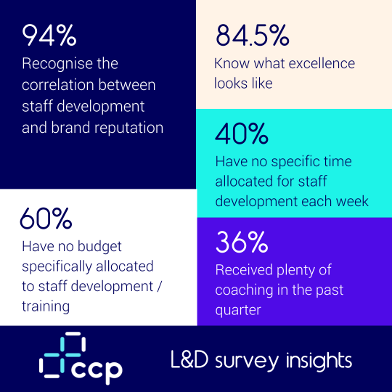
84.5% of participants in the survey believe that they know what excellence in their role looks like. However, the ability to demonstrate this to customers and to clients is something to be considered, how can we ensure that we are measuring and reporting the service that is being delivered? Measures like CSAT are always considered, however the retention of both customers and critically employees, which could be the most significant metric as staff who are engaged, know their role, are confident in their delivery are happier in their work, they will not only delight customers but will be less likely to leave due to feeling undervalued. This results in unquestionable benefits the employee, customer and business.
“It is essential that leaders and managers have the capability to maintain a culture where people can connect with the role”
The ability to deliver continuous feedback in the right way so that people feel supported and empowered is critical to people wanting to, and being able to share that knowledge with customers.
Staff development plays a huge role in brand reputation, perhaps as an output of increase productivity and delivery of service levels, with 94% suggesting a strong correlation to the impact on this.
However there was sometimes a clear disparity between the amount of time available for staff training and the recognised benefits equally there were times when the time available was much higher than expected. Another key theme was there was a gap between in knowledge about what specifically people needed to be trained on, to ensure that there is value in coaching there needs to be better analysis as to where the training is needed and what technology can be used in supporting this.
Ensuring that coaches and trainers have the right insights to direct training as effectively as possible can be supported by technology:
- Focusing efforts with support on the right subjects and with the appropriate delivery methods,
- These may be conversations within the operation, not necessarily removing people from the operation to sit in a training room
- Remote working needs to be considered in this context with the appropriate monitoring and support,
- Training still needs to be specific to the needs of the individual,
- Which enables us to think more about how we make training and coaching really count for the individual?
Tools like Cognexo as a micro learning solution can take as little as 2 minutes per day and be delivered through a channel aligned to the daily tasks of the staff member, therefore engagement levels are maintained above 91% as it is part of the daily routine.
Behaviour shifts are the result of the right conversations.
It isn’t always necessary to take people out of their day-to-day environment to change culture or behaviours and the role of the manager in ensuring that they are “walking the walk” being a visible leader, providing coaching and support, leading with the right insights ensures the most impact.
Managers must be able to understand their people as individuals, that the outcomes that need to be delivered for the customers require appropriate trust and autonomy due to the unique nature of customer interactions which is increasingly pertinent as AI and automation completes the easier tasks, we need to consider what measure and how we manage. Whilst this may feel obvious, the shift to home working may make access to these skills harder for our next generation of Team Leaders.
We need to listen to the experiences of the front line staff, the roles are getting harder, but we need to ensure people are allowed to contribute to the process, to provide feedback about the processes and how things may be done differently, technology may be used for surveys with employees and to consolidate those responses, with a workflow to the management to ensure that all staff feedback is captured.
“Managers need to ensure that they understand their people on a personal level”
Enabling people to review their own performance and to track against the expected levels of delivery empowers them to properly understand where they are, how they are doing and where they may need support.
This can be used as a tool to support culture change, however, when time can be limited because of operational pressures so the subject matter and insight of what training or coaching is critical to get the right support to staff at the right time.
Budgets may not always be allocated to ongoing training and investment time may not always be scheduled as often as people may like, ROI models around attrition reduction benefits and how this filters through the business in other impacts, the role of ongoing personal development to retaining staff and supporting the growth of brand reputation,
In a world of AI we still need to ensure investment in people
A 1% increase in engagement can deliver a 2% increase in productivity, there are multiple benefits as a result, using coaching and learning to deliver contact centre culture is not achieved through pizza on a Friday, technology can be useful but we need to ensure that people within the organisation are considered in the mix, from agents and first line manager levels, who need to see that the insights are being used through to the senior team who may need stronger insights to drive strategic decision making.
If you’d like to talk further then please contact me directly and we can look at how we can help.