
Will changes for other businesses lead to a realisation that contact centres have been progressive in their approach and potentially increase the recruitment pool or will contact centre leaders need to make changes to become more competitive in recruitment of the best talent?
Perhaps we are more progressive in contact centres than we give ourselves credit for?
We’ve written before around the view that despite our collective best efforts, our industry can often have something of an image problem with those on the outside, and, unfortunately, for some who work in the sector as well, because of arcane processes that may have been applied by some managers.
Working in contact centres can be tough and is seen by many as an interim role as opposed to a career path. The use of terms like CX may make it a more noble cause, even if the gap between customer ambition and realities can seem large. However, (I hope!) many people reading this article will recall a journey from a stop-gap role to a ‘proper’ career, which has delivered job satisfaction, personal development, promotions and a level of reward which affords a quality standard of living and the attainment of life goals.
You may also reflect on the flexibility that working in contact centres may have afforded you in your life, initially from being in operations in which there were options as a result of:
- 7 days per week, which may have resulted in working a weekend day, but having time off in the week,
- 24/7 operations where dealing with something through the night resulted in lieu time at a convenient time
- Creating 4 day weeks with compressed hours to enable flexibility for your staff and ensure capacity where your customers needed it
- Split shifts (ok maybe not 25 years ago, when that meant going to work twice in the same day, but post pandemic with home working)
- Part time shifts which worked around the school run or after lectures
- The ability to work remotely and therefore mitigate communing time
So, perhaps when talking about flexible working and encouraging greater control over work-life balance we should already be seeing contact centres of a beacon of what can be achieved (even if that does sometimes mean rolling rotas to ensure that customers have access to support when they need it?).
But it doesn’t end there does it?
Contact centres – through necessity in some cases, of course – have embraced the real living wage and providing better rewards for frontline staff. However, the reality is that skilled contact centre agents may still be earning similar amounts to those in roles where there may be less stress or pressure. Self-service and automation mean there are less “easy” contacts and as customer expectations and levels of knowledge increase, the role does get harder. Put simply, there is more for agents to deal with now, when considering the complexity of queries and vulnerabilities of customers.
Admittedly, where costs are key and businesses are feeling pressure to manage the cost of customer service and acquisition, then offshoring has been the norm for some time. As we know, offshoring doesn’t necessarily reduce quality, but it takes hard work to get it right. The manufacturing sector had already followed this route, in many cases years earlier. Unfortunately, our industry faces more scrutiny for moving work out of the UK than others, it seems.
The same customer service ‘exceptionalism’ may also apply to automation, with a recent Gartner survey highlighting that 64% of customers would rather companies didn’t use AI in customer service delivery.
Out of necessity the industry will keep pace with changes to minimum wage, however there will be an inevitable impact to either the cost of the product or margins. In which case more innovative techniques will need to be adopted to maximise margins.
I’d like to think we’ve been pioneers in ensuring equality. When I see news pieces around gender and representation of women in boardrooms, I reflect on the fantastic female influences I’ve had through my career, senior management and directors who have shaped my career and given me opportunities to develop.
I believe that contact centres are (for want of a better term) unfortunately ahead of the changing employment curve. I say unfortunately as contact centres’ relative enlightenment can disadvantage other sectors. I don’t have access to contact centre-specific data on gender pay gaps. And though I assume a gap is still sadly probable, I would think it is relatively lower in contact centres, based on the skill, talent and mindset that we have in the sector,
UK Contact Centre Decision-Makers’ Guide 2024“Women hold about 41% of senior leadership positions within the UK contact centre industry”
So, could this be a new dawn of realisation?
We were discussing last week the same story in multiple newspaper articles around easyJet and their recruitment of people aged 50 and above for cabin crew roles, citing their life and communication skills as a key benefit to passengers and by extension their new employer.
The shift rotas offered the flexibility of working alternate weeks, for example, or four days on four days off (I recall that over 20 years ago in contact centres we called this a continental shift pattern). This type of recruitment should open up the ability to recruit people who previously decided to leave full time employment after the pandemic back into roles.
Admittedly, customer service at 35,000ft may have more appeal for some than dealing with a phone call or webchat concerning a utility bill, for example. However, in contact centres we recognise clearly that life skills and knowledge are of significant benefit to our customers and have been recruiting from all demographics for decades.
Michael Brown, Director of Cabin Services at easyJet“We tackle misconceptions about the job and broaden horizons for even more talented people looking for a new opportunity who can bring their wealth of life experience to the industry”.
We believe that we are well ahead of other sectors in our approach to working practices and rights. Undeniably, negative perceptions evoking the ‘dark satanic mills’ persist for many and horror stories from 20 years ago (and occasionally today) remain. But the contact centre industry is probably in a better place than we are given credit for.
We will however need to manage challenges as a result of changes to legislation around worker rights, there are likely to be changes in WFM that will need to be considered, potential impacts to payroll and management of holidays.
Additionally, there may be changes harder to identify on the surface – maintaining knowledge and communications when more people work compressed hours could be one.
We have the skills and tools ready to support altered employment practices and we’ve demonstrated time and time again that we can change when needed. If you are facing challenges maintaining employee knowledge and experience, managing performance metrics or even protecting a sustainable margin in your contact centre operations then you won’t be alone.
Gerard O’Hare, WorkNest Legal Director“Once seen as a modern-day mills and bastions of the overseer, contact centres should, rightly, be lauded and credited for leading the charge for innovative working practices such as the compressed hours working week, and flexible shifts around childcare responsibilities which the industry introduced at the dawn of the contact centre”.
We are here to help, just ask.
The Customer Contact Panel team is made up of contact centre professionals who have seen a number of challenges and changes in the sector over the past 30 years, we use our experience to support both in-house operations, those wanting to outsource and outsourcers to deliver contact centres that match their ambitions whether that be sales or service.
If you have a thorny challenge then we’d love to hear about it, we share our thinking and have supported fantastic brands in finding the right fit solution for their and their employees’ needs. We have over 220 contact centre partners and 120 technology partners, we don’t have favourites only right fits for your needs.
Guest Author – Elaine Seculer (Head of Marketing at Taskaler)
As we dive deeper into the knockout stages of the Euros (dare we mention it), did you know that Pakistan is the largest producer of hand-sewn footballs? In fact, the official footballs used in the last two FIFA World Cups were crafted in Pakistan.
But there’s more to Pakistan than footballs; it’s also emerging as a leading location for outsourcing, offering unique benefits over many offshore countries that might first come to mind, which places Pakistan as an attractive alternative well-worth considering.
We speak with Jawad Farooq and Elaine Seculer of Taskaler to get the inside track on Pakistan as the latest outsourcing destination of choice!
1. The Rise of Pakistan in the Outsourcing World
When you think of outsourcing, countries like India, South Africa, and the Philippines are the destinations you probably first think off. They’ve been popular choices for years. However, these markets are becoming saturated, with increased costs being felt of late – that’s where Pakistan steps in!
A hidden gem if you may, not yet overrun with competition, meaning you can find high-quality talent at very competitive rates. Early birds in the market are already reaping the benefits!
2. Why Pakistan is Cost-Efficient?
Pakistan’s stock market has seen unprecedented levels of growth of late. The KSE-100 Index, tracking the largest companies listed on the Pakistan Stock Exchange is at a 6 year high, making it the top performer among Asian frontier markets, thanks to improving economic conditions and a favourable IMF deal which boosted investor confidence.
Whilst the country’s currency (rupee) is relatively weak, this has been highly favourable for international businesses who receive a healthy exchange rate against the dollar.
Did you know? Pakistan’s outsourcing rates are even more competitive than India’s, which has long been the go-to for outsourcing!
3. English Proficiency and Education
Pakistan’s Constitution and Laws are written in English. English is recognised as the official language and is widely used in business and higher education. This means that communication is smooth and easy, with about half of the educated population speaking English.
4. Big Brands and Business Environment
Pakistan is already attracting big brands, with businesses like Audi, BMW, Samsung, Unilever, Nestle, Carrefour, and Standard Chartered all successfully running their operations in Pakistan for years now. This shows that Pakistan has the infrastructure and capability to support large-scale business operations. Plus, with Pakistan being four hours ahead of British Summer Time (BST), you can easily set up shift patterns that cover your core business hours, making it convenient for meetings and collaboration.
5. A Thriving Start-Up Scene
Pakistan isn’t just about established companies; it’s also buzzing with start-up activity. There are numerous start-up incubators, funded by both private investors and global giants like Google, fostering a vibrant and innovative ecosystem.
Piqued your interest?
If you’re curious and want to explore more, drop us a line – we’d be more than happy to help you discover all that Pakistan has to offer for your business!
Manufacturers are having to grapple with a vast range of challenges; supply chain difficulties, skills gaps, changing commercial and distribution models, harnessing the potential of automation and AI, to name just a few. In which case the role, purpose and configuration of contact centres may seem like a question for another day.
But communicating with and managing customers is now a core undertaking – and manufacturers changing how they do it can have significant positive impacts across the rest of their business.
Customers, customer everywhere!
Managing customers in a commercially effective and brand-enhancing manner is a challenge, but the first challenge is often to define exactly who those customers are.
For manufactures they may well include: end-users, service and maintenance providers, sales agents and distributors, logistics and shipping agents, governmental agencies – as well as colleagues such as finance, billing, mobile engineers and so on.
All these customers have their specific needs and expectations, but all need to be handled and addressed in a manageable way, with best practice techniques developed, optimised and consistently deployed.
The financial case for consolidation of contract centre activities is often obvious, but the adoption of new contact centre advisor-supporting tools and technologies now make a high-performing, multi-skilled service a feasible reality.
A tower of babel?
Today, very few manufacturers can afford to operate in a single language market or markets. Globalised supply chains mean that – whether selling direct to end-users or through dedicated or networked agents and distributors – manufacturers inhabit a multilingual world. Without the ability to interact remotely with customers across most or all of the languages they use, firms will limit their scope to penetrate overseas markets and/or rise up the value chain with the product/service proposition.
Irrespective of the undoubted advances made in translation technologies which can enable multilingual customer support, operating a multilingual contacts centre – be that in a centralised hub, or through distributed in-country operations – is very challenging and costly. Increasingly, the skills to do so successfully – and leverage those supporting technologies – is a specialised undertaking.
Facing up to the cybersecurity threat
The threat from cybercrime and data security challenges more generally grow and grow. Aviva’ research suggests that 20% of UK businesses are subject to cybercrime annually (https://www.aviva.com/newsroom/news-releases/2023/12/One-in-five-businesses-have-been-victims-of-cyber-attack-in-the-last-year/ ) and the impact of such crime is increasing as organisations’ digital shifts progress.
Distributed, ill-managed systems and lines of communication often present firms’ greatest areas of vulnerability. Added to which ‘social engineering’ and scammers’ targeting of individuals employees continues to account for most points of corporate failure, giving criminals access to vital systems and data.
Professional, secure and well-trained contact centre operations can provide a robust defence against the cybercrime threat. Again, a consolidated contact centre function, with tested processes and technology to underpin data control, isn’t a guarantee of cyber resilience. But it’s a great way to address threats whilst building internal coherence and capabilities.
Need to talk?
Customer Contact Panel based in Sheffield, a city with a proud industrial history and a strength in advanced manufacturing technologies. So, we know a little bit about manufacturing, but we know a lot about contact centres! Contact centre services are intrinsic to the manufacturing sector’s success. We can help guide firms through the best approaches, infrastructures and technologies to deliver the best customer management. This includes outsourcing to specialist providers who can deploy their expertise and insight, allowing manufacturing firms to focus on developing their products and services.
We’re always happy to chat. Get in touch
Last week I sat with a former client who said that the average sales cycle for them to sell their SaaS product has increased from 3 to 9 months. This reflects a general trend we have detected in conversation after conversation with both clients and partners. Across the board, we are finding that decisions are slowing, the criteria used within organisations to arrive at decisions are being changed mid-process and apparently settled courses of action get delayed deferred or de-railed by new initiatives.
So, why is this? Does it matter? And if it does, what can you do about?
Expect Delays
Lots of businesses – perhaps especially their customer-facing operations – have gone through a torrid 4 or 5 years of near-constant change. The pandemic, mass home-working, the ‘mass resignation’, surging inflation, supply chain disruption and war, both near and far from home, have all served to create massive disruption and demand rapid responses and decision making. However, this sort of forced decision-making and change is draining, both organisationally and at an individual level.
So perhaps it’s no surprise that organisations are less confident about their abilities to identify the right questions and make the right decisions about them. Uncertainty – fuelled in the UK and US by imminent elections – continues and now feels like a constant for all businesses. At the same time, genuinely profound challenges need to be addressed as organisations face the type of fundamental questions that just weren’t on the corporate agenda a few years ago:
- What will the real impact of AI be – and can we prosper from it?
- Is our business model tenable as we enter further into the climate emergency?
- Will our current customer experience approach and operational model be fit for purpose if we genuinely embrace support people with vulnerabilities?
- How can we exploit automation and granular customer insight if we can’t retain staff and deliver the customer service basics?
Maybe it’s no wonder the capacity and appetite to do so seems to be waning.
Delays may be fatal
Does delay matter? Well, you can argue that profound and existential decisions shouldn’t be rushed. Certainly, an ill-thought-out response to a developing challenge might be costly. But at a point when the pace of competitive challenge is quickening, unnecessary and unplanned delays just sap business confidence, revenue and profitability. Research conducted with senior decision makers showed that 89% believe that organisations taking too long to make decisions risk getting left behind (Orgvue Research).
What’s to be done?
When organisations are becoming slow and indecisive it might seem like there’s nothing individuals – even those in powerful positions – can do. However, there is scope to improve clarity about the decisions to be addressed, the basis on which to make them and your ability to deliver on them:
1) Open things up – rapid decision making won’t help if the range of choices is restricted or inappropriate. We need to understand the underlying challenge – be that a business difficulty or a new opportunity – and then frame the choices to be made. To do so, it may well help to open up that process. Get input from colleagues – at all levels – partners, suppliers and even through observing your rivals. There’s no shame in emulating smart people!
2) Define the decision-making process – once you are confident that you understand where your priorities lie, and the decisions required – about products, people, technology, investments or partnerships – then be very clear about how those decisions will be made. Who will be in the room, what are ranked considerations to be taken into account, what criteria will be used to make decisions – and measure the success of their implementation and effects.
3) Get some help from your friends – you – and your customers – know more about your organisation than anyone else. But getting third-party support and insights from trusted partners can be invaluable in:
- Crystalising your key business challenges (or describing them to a wider internal audience of stakeholders)
- Helping you assess options and possibilities, including the providers of services and technology that will be needed
- Building the assessment and measurement criteria you will need to frame, make and deliver key decisions
Where does Contact Centre Panel fit in?
We work with scores of clients and hundreds of partners every year, helping them make and carry out decisions that are fundamental to their organisational performance. We don’t have all the answers (or questions), but we would love to help understand the frustrations and delays you might be experiencing. Odds are, we have come across a similar scenario or challenge before – or know someone who has.
Let’s have chat and see if we can get things moving again. It could be your best decision of 2024 so far!
Are there really no bad ideas? This age-old question plagues organisations that are trying to innovate while managing realistic resources and budgets. None of us want to stifle creativity—we’re all encouraged to think creatively and bring new ideas. As we alluded to above, maybe it’s the execution of ideas that results in undesirable outcomes.
Distributed and Contact Centre Panel (CCP) recently teamed up to help more organisations turn their ambitious ideas into reality. Any idea is worth exploring, but without proper execution, outcomes are often lacklustre at best and failures at worst. In a tech landscape where 70% of transformation projects end up failing according to McKinsey, it’s critical to get the strategy and process right at the onset.
We want to set business leaders on the best path possible toward successful digital transformations. With our combined expertise and years of experience in helping companies implement change across industries and geographies, we’ve compiled the guiding principles that will be foundational to any large-scale technical project.
Be clear on strategy and your “why” at the start
Nobody sets out to do a bad job. The execution of a project—especially in an outsourced environment—is complex, so it may not be a specific decision that halts progress, but a situation where people fail to make a decision, or don’t work through the priorities and therefore are trying to work with limited resources.
Distributed Founder, Callum Adamson shares, “Make sure you’re in love with the problem you’re trying to solve, not the solution you think is needed. I see people thinking, ‘I’ve got this great idea for an app,’ rather than ‘This problem needs to be solved.’” Clearly defining the priorities of a project will ensure that everyone is working towards implementing the agreed upon change. When resources are limited, there’s no more important factor to a project than knowing exactly how it will affect the organisation once the project is finished. In order to better track the impact of your change implementation, make sure to identify:
- Key KPIs that will be measured before and after the project
- Goals for those KPIs in order to track against expectations
- Teams that will be affected directly by the transformation
- Stakeholders who deeply understand the problem you’re trying to solve
Make sure you have the right resources dedicated to the project
Change is inevitable in any organisation and if we fail to acknowledge this then those organisations are destined to fail. Opportunities to deliver additional customers, revenue, or margin are dependent on successfully implementing change. The step that makes something a “bad idea” is potentially the decision to not apply the appropriate level of thinking and resources to the project.
Once you understand the parameters of your project and exactly how the change will affect your organisation, it’s time to set out for the right resources. Good ideas become bad ideas when the levels of critical thinking and creativity don’t match the complexity of the project. Make sure there’s enough time, budget, and talent dedicated to the transformation project in order to move forward completely. If there isn’t, be realistic about what you can accomplish with what you have, and flex your creativity to stretch those resources in ways that will help your team make more progress.
At CCP, nearly a decade of work has been dedicated to honing in on connecting organisations to the best resources for their projects. CCP Founder Phil Kitchen shares, “We always see that the best fit organisations to support our clients or network have three key components to their offer. These are:
- Solution, that the needs are clearly understood and the partner is aligned to the same objectives
- Commercials, ensuring sustainability for all engaged to deliver a win/win outcome
- Cultural alignment, to ensure open and transparent communications and delivery
Leverage the right talent at the right time
What truly needs to be considered when making any critical change is that there needs to be the necessary capacity to deliver change whilst managing the day-to-day goals. Impactful change can only be achieved with impactful teams, and sometimes those teams need additional expert perspectives and skill sets in order to more holistically drive a project forward.
This is where leveraging external talent becomes the key to driving innovation at growing organisations that are moving quickly while simultaneously implementing ambitious transformations. We have a deep understanding that success can’t be achieved in a silo. In order for internal teams to excel in their “zones of genius,” they need the right support to enable an open, empowering environment for better productivity and workflows.
Freelancers make up 40% of the digital workforce today. That’s a tremendous amount of talent that can potentially help organisations shift their businesses through successful transformation projects. This talent remains largely untapped today, even as business leaders become more open to the idea of leveraging talent ecosystems outside their own companies. With this leap comes global perspectives, remote working practices, and increased productivity that can be unlocked with the right talent strategy.
We’re building the future of tech transformation—join us
CCP and Distributed are partnering to help organisations achieve greater change at faster speeds—without compromising on quality. Keeping this balance is important to us because we know it’s important to business leaders worldwide. As we continue our work, see how good ideas can become great ideas when the right talent teams can contribute their unique skills sets and expertise to your projects.
I always think back to a certain Benjamin Franklin quote when we talk about learning, that being “Tell me and I forget. Teach me and I remember. Involve me and I learn.” For a quote that is over 300 years old, it certainly does resonate today.
However, with recent challenges in the industry, be that COVID-19, the cost of living and other hardships, opportunities for employees to learn and experience personal growth have been somewhat limited. Surely something needs to change?
What do the stats tell us?
Recent studies underscore the importance of continuous learning and development for call centre professionals:
- 44% of employees in the service sector will require reskilling during 2023 to meet the demands of evolving job roles. This will rise to 57% over the next 5 years (Future Skills);
- 87% of call centre leaders believe upskilling and reskilling are essential, yet only 40% feel prepared to address the skills gap (McKinsey);
- 32% of customers would leave a brand they loved after just one bad experience. With well-trained call centre staff, companies can mitigate these negative experiences (PwC); AND
- Companies that invest in employee training and development see 21% higher profitability due to increased employee productivity (Gallup).
Quite telling stats don’t you think?
What is clear, is that the numbers collectively highlight the critical nature of proactive upskilling and reskilling in the service sector. Businesses that prioritise and act on this will not only safeguard their employees and customers but also realise enhanced profitability and future-readiness.
Making it personal
It’s always important to remember that no two employees are the same. Businesses need to ensure each employee’s learning journey is highly personalised. There needs to be a departure from the ‘one-size fits all approach’ that many standard training and induction courses deliver.
AI-powered, learning and development solutions help with personalising a learner’s journey, as these platforms can identify and close knowledge and skill gaps whilst giving managers the analytics to see exactly where those gaps are.
Rather than having to redeliver training on a whole subject, they can focus on the content that is performing the lowest, thus freeing up time and budget.
Solutions that are bucking the trend
Such solutions are helping to quash these stats by embracing the principles of continuous engagement and development, helping to create a deep sense of ownership in each employee’s learning journey.
I recently sat down with Georgia Harbison, Head of Sales at Cognito Learning, to discuss her thoughts on these statistics:
“The statistics speak for themselves. Investing in L&D and upskilling for contact centre staff is not just a nice-to-have; it’s imperative. As the nature of customer interactions shifts and the role of call centre professionals evolves, continuous learning will be critical to success. Businesses that recognise this and invest in their employees’ growth will not only see improved customer satisfaction, but, will also benefit from improved staff loyalty and productivity as well as enhanced profitability.”
Sound familiar?
If you too are going through a renaissance with your learning & development strategy, then give us a shout. We can help to supercharge your employee’s learning journey.
In the fast-paced world of contact centres, where efficiency and productivity are paramount, the value of team meetings and huddles is often underestimated. Whilst some team leaders thrive, using this opportunity to have rich and helpful conversations with their team, others see it as ‘wasted’ time, and some simply don’t know how to fill the allocated time – so it becomes a coffee/vape break!
In this article, we’ll delve into the importance of team meetings and huddles in contact centres and how they contribute to creating a more cohesive and productive work environment.
5 Reasons Why
- Enhanced Communication and Collaboration – team meetings and huddles can serve as vital platforms for open communication. They can provide an opportunity for team members to discuss concerns, exchange ideas, and offer support. The more this happens, the more trust grows, which in turn fosters a collaborative spirit, enabling individuals to work together seamlessly towards common goals (which aren’t always measured with a metric!) Through regular honest, open and real conversations team trust leads to understanding, ultimately driving improved teamwork, productivity and performance.
- Boosted Morale and Motivation – team meetings offer a space to celebrate achievements, big or small. Recognising individual contributions creates a positive atmosphere and reinforces a sense of purpose and belonging among team members. This, in turn, translates to increased motivation and a greater sense of pride in one’s work. There is a risk that the ‘coaching-culture’ in contact centre creates an environment in which problems are solved, but wins are not noticed. The downside of this (as well as the negative impact on morale and productivity) is that successes are not actively learned from, so cannot be systemised and repeated.
- Problem-Solving and Knowledge Sharing – wouldn’t it be great if every day ran smoothly, and all customer concerns were easily dealt, in a timely manner, using intuitive and interconnected tech … but things don’t always go that way. Sharing experiences and best practices in huddles/meetings can lead to innovative problem-solving approaches from within the team. The co-creation of solutions is both empowering and motivating. Moreover, it allows for the dissemination of knowledge, ensuring that all team members are equipped with the tools and information needed to excel in their roles.
- Priority and Self Management – huddles and team meetings provide an opportunity to set priorities, allocate resources, and streamline workflows. By ensuring that everyone is aligned with organisational objectives, daily targets and team goals, these gatherings contribute to a more structured and efficient operation.
- Empowering Employee Voice – every team member plays a vital role in the success of a contact centre, and their perspectives are invaluable. Huddles and team meetings can (and should) create a safe space for employees to voice their opinions, concerns, and suggestions. This not only makes them feel heard and valued but also allows for a diversity of ideas that can lead to innovative solutions and improved processes. This further builds the sense of trust, belonging and connectedness to the organisation, which further helps performance and productivity.
Conclusion
Team meetings and huddles are not merely obligatory gatherings; they are indispensable tools for creating a cohesive and productive work environment in contact centres. Think about it, a simple huddle can contribute significantly to the success of the organisation as a whole – that’s surely worth 5 minutes of the day?
By recognising and leveraging the value of these meetings, contact centres can build stronger, more resilient teams that are poised for success in today’s competitive business landscape.
Looking for ways to empower your team and unlock their potential? Get in touch, we’re here to help.
For many the OOO (out of office) was in action over the summer, the best I ever received went along the lines of “I’m away, returning on DD/MM, when I return I will delete all my emails, so mail me again after that date” I was outraged at the time, but now I’m older, well… I still couldn’t do it.
Anyway, now people are back and it seems, are back to the actual office in increasing numbers, what 5 things would make our roles more productive and effective between now and the end of the year?
We are fortunate to speak with lots of people at Contact Centre Panel and through our conversations over the years these are my standout quotes:
- If everything is a priority, then nothing is a priority: wise words, if you are trying to do too many things then it is likely that none of them will get done, make a shorter list or ask for help where you need it.
- Focus on your core: I do mean business not the type developed by doing the plank (that said I maybe need to do both types), clearly all businesses need to evolve but know when you need to perhaps outsource part of the work so that you can focus on what you do best.
- Learn from others’ mistakes: come on we can’t all sit here and pretend we got it right all of time, taking the experiences of others to improve your own operations, customer experience or sales doesn’t mean you have to hand everything over to an outsourced solution it may be that you need someone to come in and support for a while, but use their experience, it could be a shortcut.
- If you are going to automate it: make sure you fixed the processes first. Also ensure that you are automating the right processes not just the ones that you don’t like doing.
- Look after your people: there is a well quoted Richard Branson post that I’ll probably be paraphrasing but make sure you give your people the tools and the support they need to shine, helping to do the right thing for your customers. Those things may not be easy, but if you train and support your people right they’ll be loyal to your brand and create fans.
If we can help with any of these then don’t be shy, just ask.
What Winter does highlight is the vice like grip the cost of living still has on us Brits, and it’s no wonder why we are all worrying about money.
Whilst some are trying to tackle the gap in pay in their own way (overtime or 2nd jobs), over two-thirds (68%) of UK employees with money worries do not tell their employer about their concerns [Wagestream]. Of this 68%, most cited the feeling of shame and embarrassment, or a cultural belief that you shouldn’t talk about your finances with others. Some cited a lack of trust in their employer – or a fear of discrimination or job loss once their issues had been divulged.
Tackling the mental health stigma
Whilst progress has been maintained in tackling the mental health stigma as a society, people are much more likely to talk about their mental health in the workplace. If we want to open the conversation so people can improve their financial wellbeing, we need to do the same with money.
3 ways employers can tackle the money stigma at work
- Train money champions to signpost and be visible: There’s been progress on the mental health stigma and one of the reasons is the success of the Mental Health First Aiders and similar schemes. Without training, it can be hard for managers and colleagues to know what should and shouldn’t be said, but this type of training gives confidence that makes people approachable but also more likely to open a conversation.
- Never waste an opportunity to talk about money: It’s not only societal trends that offer opportunities to talk about money. Internal changes, such as promotions, are good opportunities to encourage employees to review their short-term and long-term financial goals. The same is true of external changes in an employee’s life: for example when people apply for mortgages they often talk to their HR department. o Don’t waste these opportunities to start a dialogue – it’s a great way to build trust with employees. In fact, nothing says you’re more open to having a conversation than by clearly showing you’re interested in starting one. If you have money champions, using them to start conversations within their departments or cohorts can be an easy way to take action at scale.
- Celebrate Talk Money Week throughout your organisation: Talk Money Week is a yearly campaign aimed at encouraging conversations about money – it’s not limited to the workplace, but it’s an ideal existing initiative that organisations can use as a catalyst for their own plans. In 2023, Talk Money Week begins on November 6th. Spearheaded by the Money and Pensions Service, Talk Money Week offers a participation pack for employers looking to take part, that includes various useful materials and insight so you can get off to a good start. It’s a great way to start a conversation internally and provides a yearly date for your diary.
Are there ready-made solutions out there?
We have seen some innovative solutions out there that are tackling this issue head on. However, the best solutions we’ve seen at CCP work with some of the top brands in the UK to provide in-depth financial education materials to help staff with budgeting. One includes the use of an intuitive app which provides employees with an easy way to help manage finances all in one place.
Such solutions have seen huge improvements, with one UK business citing the following since introducing said programme and app:
- Increased retention by up to 16%
- Increased shifts worked by up to 26%
- Reduced payroll queries by up to 40%
By rolling out such a programme, the business in question has been able to retain good people, who are doing a great job in looking after their customers.
That feels like a win-win to me!
Looking for help?
Need help in planning a better financial future for your employees? Let us know,
For lots of contact centres the recruitment and retention of frontline advisors continues to be their biggest challenge. The labour market has shifted, maybe permanently, and potential colleagues’ expectations have changed. At the same time technology developments promise to revolutionise contract centres and how they operate.
Good people are hard to find and good people expect to be recruited honestly and treated properly in work. So, are your current recruitment approaches fit for purpose?
Attitude, Aptitude and Experience
Recently I came across the ‘3As’ hiring model that Ralph Kasuba developed in the late ‘noughties when recruiting technology hires. The three As are the three sets of characteristics that candidates have and Mr Kasuba suggested the priority order in which they should be assessed:
- Attitude – your innate approach to work
- Aptitude – your ability and willingness to adapt, learn and develop
- Ability (or Experience) – what you bring to the table in terms of qualifications, technical skills and experience
The model was developed when Kasuba’s team were struggling to appoint candidates for technical roles; they would pass a pre-assessment but then never get through a team interview with their prospective peers. The 3As sought to make sure that the candidates’ ‘fit’ with the organisation and team were right before going on to assess the level and extent of their – vital – technical skills.
So, do the ‘3As’ help us in today’s contact centre world? Potentially, but perhaps not yet!
The present
Everywhere you turn nowadays you can read predictions and descriptions of the onward march of technology in the customer interaction and contact centre space. Innumerable articles – most written by Chat GPT and some with the aid of human intervention – explain that the old contact centre world of complex manual processes and work-arounds is about to disappear under the shiny onslaught of machine learning and AI.
If these articles are even partly correct then the sort of people we need to attract to work in the frontline of contact centres needs to change. However, as long as contact centre advisors are expected to the below, then Experience and Aptitude will continue to trump Attitude in attracting and selecting candidates:
- Cope with multiple tools and systems (with more added all the time)
- Retain a good understanding of internal and customer-facing processes ‘in their heads’
- Prioritise multiple demands and requirements (mandatory statements, data protection compliance, data capture goals, up or cross-sell targets, quality management criteria, etc)
The future?
As systems are integrated, real time guidance is available to advisors to help them identify and resolve issues and – crucially – the contract centre is seen as a means of identifying and fixing broken processes, then things will change. Maybe then recruiting people mostly for their empathy, enthusiasm and communication skills will become possible.
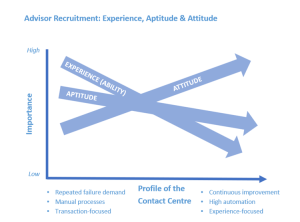
In the meantime, if we want to retain the right people to help and support our customers it will continue to be necessary to accept that “what they do” is more important than “the way that they do it”.
If you’d like to discuss how well your recruitment model aligns with your present realities (and future ambitions) just drop us a line, we’d love to chat with you.
P.S. if you want to read more about the ‘3As’ approach you can do so by clicking here.