
In early February I attended the IP Integration “Spotlight” event at the Midland Hotel in Manchester where we were provided access to some great insights from the team and from Steve Morrell of ContactBabel, what follows are my thoughts and reflections arising:
Something around customer adoption of automated solutions has been playing on my mind, it often happens when I suggest someone talk to an automated bot solution so they can experience first-hand how far the technology has come, where it is going and what the real possibilities are.
Being in the CX world and having several partners on our network that have such solutions, I have a number saved to my phone, just for this type of conversation. If I pull the phone from my pocket, find the number, dial it and hand it someone to have a conversation then I often feel that the “conversation” isn’t as free flowing as it should be. Why? Well that is a great question.
I suppose it could be that for the past 15 years when contact centres have effectively forced customers to speak to automated voice response systems, we have typically limited customer so saying one word “listen to the following list of options and then say the option you would like” or “in a few words please say why you are calling today” so for years we’ve been saying ‘please speak to this automated system in a short staccato format’. Now, in a matter of a couple of years, some businesses are offering customers the opportunity to speak freely to their bots or automations, whilst others are still on the limited few words space. No wonder consumers get confused – and the acceptance and adoption of voice automation could well be held back as a result.
Voice is here to stay?
The truth is that voice interactions are still our favoured route of contact as customers, when it comes to getting things done and obtaining reassurance that we’ve been heard. Whilst the death of voice in contact centres has been forecast for the past 20 years, the reality remains that voice is here to stay, millennia of evolution cannot be undone so quickly. Data shared at our webinar on the State of the Customer Experience Market with David Rickard of Everest Group in November (article link) validated this, as their research highlighted that 72% of revenues amongst the outsource community were still coming from voice-based activity in 2023 when both agent supported voice and conversational AI driven interactions were considered.
The data shared in the room in Manchester by Steve Morrell of ContactBabel corroborated this view, with 64% of interactions being cited as voice in his forthcoming 2025 report. Also that we are so keen to ensure that we speak to someone that we will now wait in the longer queues that have been identified post pandemic and that we have accepted these as the norm.
So, as a human race we have a deep attachment to use of voice, however I’m still receiving articles daily which suggest otherwise – and ours is an industry which is based on employing people to talk to customers. We need to acknowledge that ‘the bots’ or automation is coming for our lunch, which according to an article in the New York Times on February 1st it may however already be in a place to arrange someone to bring our lunch and where may that end?
An article by Kevin Roose details several tasks which he managed to complete using OpenAI’s Operator, a new AI agent in the week prior. Most of the tasks it did autonomously with minimal intervention. It met its brief of being an AI agent that uses the computer to accomplish valuable real-world tasks, without the need for supervision, to complete tasks in the background with a handoff back to the user to enter passwords or payment card details. However, in Kevin’s article he talks of how it ordered lunch to be delivered to a colleague’s house and responded to LinkedIn messages well, up to the point where it started signing him up to attend webinars, amongst other tasks. There were, however, several tasks where the automation struggled or needed an amount of reassurance or confirmations. Because of which he felt that it would have been faster to do the tasks himself, but acknowledged that the AI agent is at an early stage of development.
What we do know is that the evolution of technology is only gaining pace. Peter Diamandis, founder of the XPRIZE (https://www.xprize.org/) , is cited as having said in 2020 that “the next 10 years will bring more progress than the last 100 years” Given the pace of change in the past 5 years, it is reasonable to assume that Moore’s Law will hold true in this instance – and that we need to be ready for this.
As humans we like voice, we choose voice. But if personal assistants in the form of OpenAI’s Operator or DeepSeek were to be adopted by the general public (your customers) to complete their home admin tasks, then these systems won’t have the same emotional connection to voice conversations and will be happy to interact directly with a company bot. However, how quickly will we reach that point?
Public adoption is key then?
We can implement the best solutions in the world, but if nobody uses them, what use are they?
Whatever is coming next, we have a dependency on customers to embrace and use those solutions, whether that is voice automation in the contact centre or the potential for the eventual use of “their own” automation by customers to engage with brands to resolve issues.
We’ve seen before conversations around ‘brand by-pass’. Now, using an Alexa or alternative voice-activated AI assistant to complete simple tasks is clearly the gateway to us getting to a point of asking technology to, say, engage with our utility provider to amend our direct debit or to find a cheaper insurance renewal. At this point we as individuals will have less input to what brands we choose to purchase, so then the brands that will succeed are those that are easiest for our automations to interact with.
But before we get to this utopian vision of admin free lives with our AI assistants ensuring the effective running of our homes and lives, we need to pass a point of public adoption of AI.
A 2023 report from Ipsos shows that 66% of people they surveyed globally expect that products and services using artificial intelligence will profoundly change their daily life in the next 3-5 years. Whilst this is the average, the range of responses on a country and demographic level vary considerably, with the proportion expressing this belief in South Korea as high as 82%, whilst France sees the lowest number agreeing with this sentiment at 51% (we in the UK see 58% agreeing with this statement).
Products and services using artificial intelligence will profoundly change my daily life in the next 3-5 years – 66%
So, whilst there is broad agreement that services using artificial intelligence will change our lives, what people are willing to adopt and how is a key consideration, acknowledging that some will be unable to adopt due to a variety of reasons.
The conversation at the Spotlight event therefore quite naturally centred on work that could be done to implement changes or applications of AI to better support the contact centre agents in delivering service efficiently without too much impact to the customer, generating a series of marginal gains which support the agent in resolving customer queries, potentially reducing call durations and in turn queues and repeat contacts – a series of win/win scenarios which:
- Improve service
- Reduce pressure on the contact centre team
- Reduce repeat contacts
- Reduce the time customers spend trying to get through
- Reduce costs
- Improve staff wellbeing
Changes which fulfil the appetite of businesses to implement changes and leverage AI, but consider how willing customers are to adopt these changes.
Is some re-programming required?
If we want the possible AI solutions to be successful, we will have to consider how we guide customers to use these solutions most effectively. Our industry has created a sub-optimal situation through a combination of poor customer experiences in the past, limited system capabilities and a “tell me in three words” approach. If we want customers to embrace the possibilities of technology, then we need to bring them on the journey.
Consider how self-serve check-outs have become the norm when we are out shopping in recent years . There is a journey that I’ve certainly been on to this point, which I discussed with IPI’s Sam Grant at lunch.
Coming prepared, we need our customers to come to the contact prepared to engage with AI.
Similarly, from prior experiences I soon learned that I need to stop putting my shopping bag in the bottom of my basket, then putting my items of purchase on top of it, which created friction in the process when I needed to get to my bag to enable me to pack items as I scanned them. So, ideally, we need our customers to come to the contact prepared to engage with AI (unless they don’t want to?)
Offering a choice? Do I want to self-serve or would I prefer to queue?
When I’m approaching the tills, I can see a queue for a till with a cashier or I can see available self-serve checkouts. If I can also see someone there by the self-serve tills to support me, then I can make an informed decision.
Unexpected item in bagging area! Solutions need to be flexible enough to minimise friction.
That bag I just dug out from my basket, I’ve tapped that I’ve brought my own bag, but it is perhaps heavier than the scales expect, therefore I’ve got an unexpected item. I’m removing and resetting the bag but there is a red flashing light and now I’m waiting for someone to come help me. We’ve all been there (please tell me this wasn’t just me!). The solution has now evolved, though, replacing scales either with additional trust by the retailer, or with cameras, but the result is a smoother customer experience.
Authorisation for purchase There will be times when someone must step in. If so, ensure it is done in a timely fashion.
OK I bought wine, it’s the weekend, please don’t judge me. The process to verify that I’m of age and can make that purchase has parallels also. We need to ensure that if a customer needs support then it is quickly available. Now I want those annoying flashing lights to flash brighter, because I need help to complete my purchase.
How do you want to pay? Payments need to be frictionless, tap and go, no creased banknotes!
The same will apply to your callers they need to be able to make the payment without being moved to another channel and of course you need to ensure you are properly protecting that payment data.
Do you require a receipt? perhaps we need to acknowledge that customers will want validation of their conversation, of what was committed to and that they can trust that it will be done.
It has taken me a long time to reach the point of clicking no to a paper receipt. I want to be able to evidence that I’ve paid and not just walked round the shop popping things in my bag. Part of the reason so many of us are still reverting to speaking to a human when we have an issue, other than our lived experiences of trying to explain a complex situation in 3-word blocks, has to be that we can say “I talked to …. And he said he’d sorted it”.
What does it all mean?
People are complex. The implementation of self service and automation of the simpler query types means that average contact centre conversations are now much longer than they were and with rising staff costs there is a clear pressure on businesses to make changes to reduce customer servicing costs.
There is a broad spectrum of solutions available to support businesses address these challenges, whether outsource or technology. These need to be properly aligned to your objectives, and it is likely that you may need to speak with someone around how to select, prioritise and deploy these solutions.
If you need to chat then feel free to drop us a line.
Collectively Customer Contact Panel (CCP) have a lot of experience in contact centres and CX. However, as things are changing rapidly in the world of AI, we met with CCP to discuss some of the broader considerations, including what technology we could deliver as an alternative view of what could be our probable future reality with the support of AI – we agreed we would share the output.
The art of the possible?
We can talk about the pace and the tone of this piece, however the reality is that with appropriate questions raised and some boundaries that we included (some for our amusement) the content within this 10 minute AI generated “BotCast” not only demonstrates the capabilities of AI, but raises some interesting questions and considerations as to how CX evolves and what guard rails need to be in place.
Click here and have a listen, and of course, if you want to discuss we’d be happy to deploy some of our humans.
When you assemble a room of people with extensive levels of contact centre experience, as we did for our event hosted at Sutherland Labs, you know from the noise levels over coffee there are going to be some great conversations! Add some fantastic speakers from our outsource and technology networks to share their views of the market and a lively, open dialogue around challenges and opportunities (new and old) will follow.
We are looking forward to continuing these conversations and scheduling another event. But in the meantime, how do we bring so much collective experience together in a short article that does justice to the quality of the conversations?
Navigating Business Decisions in a Rapidly Evolving Landscape
In the current environment, companies face a range of critical decisions, from implementing new technologies to fostering employee engagement. Despite knowing what needs to be done, many organisations struggle to translate that knowledge into actionable outcomes. This disconnect is often a result of inadequate systems, outdated training and coaching models, and an inability to adapt to change.
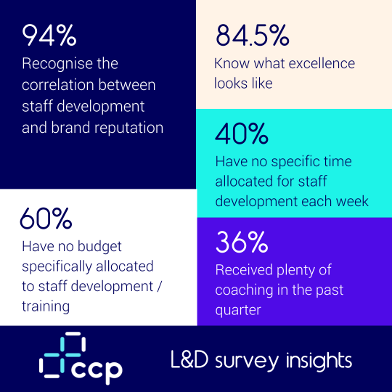
In our recent L&D survey it was apparent that there is a clear gap between knowing and doing. Results show that while employees understand their roles, there’s a significant disconnect between knowledge and execution. This is particularly evident in how businesses approach training, often relying on outdated, “once-and-done” programmes that fail to evolve alongside the changing work environment. As companies shift to remote work, many are noticing a reduction in employee loyalty and engagement, partially because of the lack of in-person interaction and relationship-building.
Addressing the Changing Needs: Evolving Training and Technology
To bridge this gap, organisations must rethink how they train their employees, particularly if they are to continue with a work from home or hybrid working model. Has enough been done to redesign training and refresher modules that better fit a virtual environment? Equally, more needs to be done to focus on continuous education rather than static, one-time courses which tick a box for compliance. Furthermore, conversational AI can be a powerful tool in reshaping learning; allowing employees to ask dynamic, evolving questions rather than relying on predefined solutions.
“Businesses recognise the correlation between staff development and brand reputation, but may not always apply the budget to ensure delivery”
AI offers the potential to unlock the true capabilities of people and data, but as we have said before is not a silver bullet. It can revolutionise business processes by supporting employees in their roles, reducing friction, and enhancing decision-making. AI can also help agents manage customer queries more efficiently, giving them access to foundational knowledge in real-time. However, the challenge lies in positioning AI correctly: not as a threat to jobs, but as a tool for augmenting human capabilities.
For example, AI’s ability to analyse customer intent and apply insights to guide agents through complex interactions can dramatically improve customer experience (CX). By properly integrating AI into business workflows, companies could potentially resolve the eternal challenge of moving from being seen as a cost centre to profit centre, unlocking new value opportunities across the customer journey.
Location strategy is still a consideration as the global market evolves. The outsourcing industry, particularly in sectors like fintech, IT support, and healthcare, appears poised for significant growth. We know countries such as South Africa have already emerged as strategic hubs for business services, offering talent and capabilities that align with the growing demand for multilingual and technologically adept service providers. Whilst there are valid concerns as to the capacity that remains available, with 33% unemployment in South Africa (60% for young people) as well as the wider continent opening for business, then combined with the capabilities of technology great opportunities remain available.
Overcoming Challenges in AI Adoption
While AI presents numerous opportunities, it also comes with significant challenges. Many process owners may be hesitant to adopt AI due to concerns about how it will impact their workforce and customer relationships. Meanwhile, senior leadership may be focused more heavily on the potential cost saving benefits. There’s a widespread misconception that AI will replace jobs, particularly in customer service. However, AI’s true value lies in assisting and enhancing human roles, not replacing them.
For businesses to adopt AI successfully, they need to:
- Align AI with company goals and culture: AI should be seen not as a technology investment, but as a strategic asset that drives both customer and employee experience.
- Shift from a cost-saving mindset to a value-driven approach: Technology shouldn’t be about cutting costs; it should unlock value, address problems at their root cause and improve service quality.
- Build the right business case: Secure buy-in from different budget owners by emphasising how AI can enhance outcomes across the organisation.
Aligning Metrics and Culture for the AI-Driven World
To fully leverage AI’s potential, cultural and operational changes are required. Business leaders need to:
- Align metrics with an automated world: Ensure that technology handles routine tasks, allowing people to focus on complex, human-centric work.
- Redefine the agent role: The agents of the future will need to deliver more value and possess different skills compared to traditional customer service roles.
- Foster a culture of continuous improvement: Embrace ongoing evolution, where AI serves to complement human skills and free up time for higher-value tasks.
- Focus on proactive engagement: Let technology handle the repetitive, allowing people to engage with customers in a more meaningful way.
- Encourage bravery in decision-making: Leaders must support bold decisions around AI investment to drive long-term success.
Rob Wiles, Zoom“AI is not the solution, it is a key to unlocking it”
Irrespective of delivery location, the future of CX delivery will increasingly rely on AI and automation to enhance customer journeys, optimise operations, and drive sustainable growth.
Transformation is never-ending. Businesses must approach AI and automation not as one-time projects but as ongoing evolutions. This requires understanding the unique challenges they face, aligning technology with business goals, and ensuring that AI enhances rather than replaces the human element.
With the right strategy, AI can unlock unprecedented opportunities for growth, helping companies stay competitive in a rapidly changing world. However, without the appropriate attention to employee experience, success will be illusory or limited.
Delivering the right experiences
At Customer Contact Panel we support organisations in delivering contact centres that match their ambitions. In a Deloitte Digital research articles from May 2024 it was cited that 55% of contact centre leaders reported that they didn’t meet their strategic goals in 2023 and 76% reported that their agents were overwhelmed by systems and information*.
If you are facing challenges meeting your strategic goals or fulfilling the ambitions you have for your people, customers or technology, we have the experience to support you. Just ask.
Like it or not, AI is coming and it will change how we talk to customers. But there are risks. What if those customers are vulnerable? Can AI look after them properly? And while we’re thinking about vulnerability, as AI increasingly consumes customer data, what needs to be done to look after that too?
On June 25th Customer Contact Panel hosted an event with CXReview at the IBM Innovation Studio in London on this very topic. Speakers included Gemma Woodcock of IBM, Jim Steven of Experian, Elaine Lee of Reynolds Busby Lee and Keith Shanks of CXReview.
Steve Sullivan of CCP was master of ceremonies and led the discussion.
Here we outline the key takeaways from all speakers for what we can do right now to mitigate those risks and set contact centres on a path to responsible use of AI.
Contact Centre AI: Not if but when
- The event focused on: Outlining the risks and considerations when implementing AI and automation, and
- The adoption scope within the Contact Centre environment, specifically supporting agents to deal with the ‘cognitive load’ when handling vulnerability and more challenging customer contacts, whilst maintaining quality and overall customer experience.
While there was much discussion around Al, Generative AI and the inevitable impact on our roles, we are still a long way from a time where agents will not be required in customer contact; we’ve evolved too far as humans for this to change. However, ignore AI at your peril.
“Consider those that did not take the internet seriously, those on the high street who failed to embrace it and look at what happened to them”
Gemma Woodcock of IBM
The AI data question
Ultimately the use of AI depends upon building models that can make predictions that add value. These are dependent on what the source data looks like. Ensuring correct identification and use of the right material is essential; wrong information can lead at best to incorrect responses and at worst to biases or hallucinations, all of which carry considerable risk to brands and their customers.
Consider also that using the questions that your customers ask you to inform future responses may not be typical – for example they may have arisen from an unusual event at a specific point in time – and if you treat them as such, this may lead to incorrect or just plain weird future responses. . Moreover, if the answers to those questions relate to your own IP and you are using open-source solutions, you may be making your IP available to others.
Additionally, who you are sourcing your solution from needs to be considered. In March 2023 alone there were 14,700 start-ups established in the AI space. Which means due diligence and an understanding of how AI solutions, which are often highly specific by nature, work together is essential.
That isn’t to say everything in AI is new. The early concepts and mathematics of AI date back to the 1950s and 60s. Over the last decade or so, increases in computing power have begun to make AI more commercially accessible. Which means AI and machine learning is already well-established in using models that look at patterns, as we’ve long since seen for Amazon purchase recommendations, or in more recent years the introduction of machine learning and explainable AI in credit scoring.
As is often the way with AI, these are specific use cases with an enormous amount of investment behind them to make them function well, particularly to allow for the use of AI in regulated industries. One aspect of these is that they depend on properly labelled data. Which is already well-ordered and highly specific in the world of credit risk. But the process of labelling data, especially data that isn’t already extremely well-ordered, is intensive and expensive.
Imagine then the complexities of labelling data in natural language usage and you begin to understand the significance of recent advances from the likes of IBM’s Watson – or the oft referenced ChatGPT – in Generative AI. In customer contact, these are what we call “foundation models”. They are pre-trained and need prompts, but can’t answer questions specific to your customers without customer data and an understanding of how customers are likely to interact. These large language models can be applied to this process – they can use
labelled data and the numerous ways to ask the same question in the past to develop further to meet your and your customers’ needs.
4 key tests for effective AI
The use of Generative AI should have 4 key considerations:
- Open: use of best technologies and innovation
- Trusted: can you trust the outputs
- Targeted: designed on specific use cases
- Empowering: ability to augment the human role/experience, not to replace it.
Pretraining and governance funnels need to be in place, with considerations ranging from the benefits of the use case to ensuring only the necessary inputs go into the model. Put simply, if nothing “inappropriate” goes in, then nothing inappropriate can come out. Additionally, this approach means it should cost less to set up the model and take less energy (power) to run. Remembering just how energy intensive AI can be, this is an important consideration.
When it comes to Risks, Regulations, and Technological requirements, there needs to be a level of governance. And during scoping of your solution, you need to consider the ongoing effort required to support it to ensure it meets – and continues to meet – strict governance. AI is not a fire and forget implementation.
AI and the bad guys

“It isn’t only the good guys that are using AI and Automation, ‘mal-actors’ are using it to enhance their processes too.”
We were fortunate to be joined by Jim Steven of Experian who shared with us some of the activity he has seen from his work in managing data breach responses. This has implications on multiple levels.
- Consolidation of data: bringing everything together to enable automation could mean that you are at greater risk if your business is breached. Additionally, using suppliers with cloud-hosted data may mean that their breach becomes your breach too.
- Benefits of automation are not exclusive to those doing good: we are not the only ones that can leverage great technology. Those with mal-intent are using it too; and they will typically do so more quickly.
- Consideration of how those impacted by a breach find the experience: when a breach occurs, it is likely that it will be across your entire estate of stakeholders. Therefore, it is not just your customers that will be impacted – it will also be employees, former employees, pension members, contractors and suppliers.
Communication with people who have had their data compromised is personal, it needs to be managed in different cohorts and isn’t really something to automate – especially with your employees, who you will need to support your customers through the situation with empathy and understanding. Not only that, but it’s important not to lose sight of the millions of customers who don’t currently interact online at all – they aren’t typically digitally savvy and may not even consider that their data is an important asset that can be used for nefarious means.. They must be informed and supported in ways that work best for them, cognisant that it is us who hold their data digitally.
Moreover, data breaches are not always one way – it’s not always about theft or ‘acquisition’ of data. Looping back to the theme of ensuring that you consider what data is held in the system for interpretation, bear in mind that even the simplest upload of additional data to your systems can impact operations. For example, there was an accidental, entirely innocent, upload of bad data to air traffic control systems in 2023 that resulted in 98% of aircraft being grounded.
People accessing and uploading bad data to your network could equally paralyse your organisation. Be mindful that centralising your information management may enable system vulnerabilities that could be exploited.
What about vulnerable customers and AI?
Elaine Lee joined us to speak about vulnerable customers and the need to ensure that we are considering them in our approach to technology and process solutions.
“40% of Companies are not doing well enough when identifying and supporting vulnerable customers.”
The FCA considers 52% of UK population to be vulnerable. The impact of the cost of living crisis on the UK population is that 25% of adults now have low financial resilience and the drivers of vulnerability are varied, including:
- Health
- Capability
- Life Events
- Resilience
- Equality
- Access
Remember, vulnerability isn’t static. We may be displaying vulnerability and require additional support today, but not in a few weeks’ time.
With 40% of companies already not doing well enough when identifying and supporting vulnerable customers, how will the introduction of AI affect those customers? Of course, there is a spectrum of risk. So it’s important to understand who and where your customers are on that spectrum at any given time, and the potential for harm – understanding what they are vulnerable to?
People may also be vulnerable through lack of access or confidence with digital tools, they may be under pressure financially through the continuing cost-of-living crisis or low financial resilience, they may be experiencing a physical or mental health condition or going through a life event that changes their ability to make decisions in the usual way.
When implementing changes, ensure that you have properly tested your solutions to work effectively for vulnerability. Use diverse customer panels and map the possibilities for different customer types. The effort needed to get it right does have a financial impact on your business, but if you succeed it will reduce customer complaints, increase engagement and therefore increase customer value.
Use cases and how to implement AI safely in Contact Centres
CXReview’s Keith Shanks rounded up the presentations with a reminder of the history of automation and AI use in contact centres. He highlighted the predictive dialler as being a key example of great technology that when implemented either badly or with mal-intent, has negatively impacted consumer perception and experience.
“Automation in Contact Centres: It isn’t new. It’s been around for years with mixed results through implementation.”
Due the nature of the customer contact operations, there are plenty of use cases that can be considered for development and implementation.
- Ensuring consistency and pace
- Automation of decision making
- Increased accuracy
- Assisting agents in dealing with complex customer contacts
- Enabling access to the right information at the right time.
However, we need to be cognisant of the potential challenges and ensure that these are properly addressed.
- Data privacy
- Security
- Vulnerabilities of both organisations and individuals
- How we ask our people to engage with the use of technology
With great opportunity comes great responsibility
If you would like to discuss more around how you are implementing AI and automation within your organisation and what it may mean to your people, customers or processes, then please contact the team.
Additionally, we are able to provide access to content from the day if you would like to read further.
Last week I sat with a former client who said that the average sales cycle for them to sell their SaaS product has increased from 3 to 9 months. This reflects a general trend we have detected in conversation after conversation with both clients and partners. Across the board, we are finding that decisions are slowing, the criteria used within organisations to arrive at decisions are being changed mid-process and apparently settled courses of action get delayed deferred or de-railed by new initiatives.
So, why is this? Does it matter? And if it does, what can you do about?
Expect Delays
Lots of businesses – perhaps especially their customer-facing operations – have gone through a torrid 4 or 5 years of near-constant change. The pandemic, mass home-working, the ‘mass resignation’, surging inflation, supply chain disruption and war, both near and far from home, have all served to create massive disruption and demand rapid responses and decision making. However, this sort of forced decision-making and change is draining, both organisationally and at an individual level.
So perhaps it’s no surprise that organisations are less confident about their abilities to identify the right questions and make the right decisions about them. Uncertainty – fuelled in the UK and US by imminent elections – continues and now feels like a constant for all businesses. At the same time, genuinely profound challenges need to be addressed as organisations face the type of fundamental questions that just weren’t on the corporate agenda a few years ago:
- What will the real impact of AI be – and can we prosper from it?
- Is our business model tenable as we enter further into the climate emergency?
- Will our current customer experience approach and operational model be fit for purpose if we genuinely embrace support people with vulnerabilities?
- How can we exploit automation and granular customer insight if we can’t retain staff and deliver the customer service basics?
Maybe it’s no wonder the capacity and appetite to do so seems to be waning.
Delays may be fatal
Does delay matter? Well, you can argue that profound and existential decisions shouldn’t be rushed. Certainly, an ill-thought-out response to a developing challenge might be costly. But at a point when the pace of competitive challenge is quickening, unnecessary and unplanned delays just sap business confidence, revenue and profitability. Research conducted with senior decision makers showed that 89% believe that organisations taking too long to make decisions risk getting left behind (Orgvue Research).
What’s to be done?
When organisations are becoming slow and indecisive it might seem like there’s nothing individuals – even those in powerful positions – can do. However, there is scope to improve clarity about the decisions to be addressed, the basis on which to make them and your ability to deliver on them:
1) Open things up – rapid decision making won’t help if the range of choices is restricted or inappropriate. We need to understand the underlying challenge – be that a business difficulty or a new opportunity – and then frame the choices to be made. To do so, it may well help to open up that process. Get input from colleagues – at all levels – partners, suppliers and even through observing your rivals. There’s no shame in emulating smart people!
2) Define the decision-making process – once you are confident that you understand where your priorities lie, and the decisions required – about products, people, technology, investments or partnerships – then be very clear about how those decisions will be made. Who will be in the room, what are ranked considerations to be taken into account, what criteria will be used to make decisions – and measure the success of their implementation and effects.
3) Get some help from your friends – you – and your customers – know more about your organisation than anyone else. But getting third-party support and insights from trusted partners can be invaluable in:
- Crystalising your key business challenges (or describing them to a wider internal audience of stakeholders)
- Helping you assess options and possibilities, including the providers of services and technology that will be needed
- Building the assessment and measurement criteria you will need to frame, make and deliver key decisions
Where does Contact Centre Panel fit in?
We work with scores of clients and hundreds of partners every year, helping them make and carry out decisions that are fundamental to their organisational performance. We don’t have all the answers (or questions), but we would love to help understand the frustrations and delays you might be experiencing. Odds are, we have come across a similar scenario or challenge before – or know someone who has.
Let’s have chat and see if we can get things moving again. It could be your best decision of 2024 so far!
In the realm of customer service, contact centres play a central role. They have become a primary interface for brands, influencing customer experiences and shaping brand reputation. The role of the Contact Centre agent has evolved too. Today, they are true brand ambassadors, whose behaviour can have a direct impact on whether a customer chooses to make an initial or repeat purchase, or recommend the organisation to others.
However, empowering agents to provide the best possible customer experience is often easier said than done. Increasingly high consumer expectations, a raft of regulatory requirements and challenging market conditions – where many businesses are required to do more with less – make it harder for agents to deliver the desired level of service. Growing workloads, the pressure of juggling remote work, and the need to master multiple, disparate technology solutions only add to the challenge.
Against this backdrop, it is perhaps little surprise that agents sometimes struggle to show their human side. Brands need to find a way for their teams to deliver the friendly, empathetic, personalised and efficient service that underpins long-term customer relationships.
Let technology take the strain
It may sound ironic but the answer to helping agents be more human is technology. For example, increased levels of automation remove the burden and frustration of having to deal with mundane and repetitive enquiries, freeing up agents to focus on more complex or rewarding interactions; those that require a high degree of intuition, understanding and problem-solving.
With the right technology at their fingertips – and the skills required to get the most out of these solutions – agents can be transformed into ‘Super Agents’ or ‘Augmented agents’ who leverage automation tools, AI, and data insights to speed up resolution times while, at the same time, offer a personal touch. The impact of Augmented Agents extends far beyond immediate interactions to ultimately influence customer loyalty, brand perception and overall business performance.
Helping humans be more human: a five-point plan
To help agents interact with customers in a more human and authentic way, brands should focus on five key areas:
- Look at ways to streamline technology. Disparate tools and solutions slow down the customer journey and are cumbersome for agents to use. Instead, organisations should explore platforms that support single desktops, and which integrate Knowledge Management and Agent Assist technologies to serve up the very latest information in real-time. This ensures agents never have to go searching for answers and can have total confidence in their decision-making capabilities.
- Explore AI and automation tools. Customer enquiries are growing in number and cover a vast array of topics, so it is vital that simple, repetitive queries and tasks are dealt with automatically. Voicebots, chatbots and other self-service tools, as well as caller identification and verification (ID&V), are all ways to divert work from humans to machines. What’s more, as these tools speed up resolution times, customers benefit too. On a more sophisticated level, companies can deploy AI to analyse customer insights and assess how they might be feeling. Armed with this information, agents can adapt their tone or approach to deliver a much more empathetic customer experience. This is particularly useful when assisting vulnerable customers or handling complaints.
- Gamification and Performance Management tools are an effective way to keep agents motivated, guarding brands against the high attrition rates that afflict so much of the contact centre industry. Gamification techniques make everyday tasks more fun and are proven to boost productivity and employee engagement. Brands should combine this approach with Performance Management tools, which provide managers with a clear picture of their top performers. This visibility is especially important in hybrid working environments.
- Workforce Management. Investment here provides agents with far greater flexibility over their schedules – including over when they work from home and when they come in to the office – while at the same time optimising staffing levels. Not only does this enhance employee satisfaction it also ensures operational efficiency.
- Technology is only one part of the puzzle; new solutions need to be complemented with comprehensive learning and development programmes that equip agents with the skills they need to deliver exceptional customer service. Feedback, training, coaching and other personal growth opportunities should be readily available and encouraged. Learning opportunities shouldn’t be limited to how to use different tools and touchpoints, they should also cover soft skills, so agents can seamlessly resolve the most challenging and complex of interactions.
As the face of the brand, it is vital that Contact Centre agents have the correct tools and sufficient time to deliver truly exceptional service to each and every customer. By prioritising the employee experience in this way, organisations can boost engagement and slash attrition rates while at the same time handle complex enquiries and deliver truly personalised service. Ultimately, by allowing agents to be more human, brands will see an uptick in customer satisfaction, loyalty and revenue.
Is your centre in need of a human touch?
Drop us a line. One of our humans would love to chat with you!
AI and the march to automation is a hot topic right now, with much being made of the gains that can be made through AI handling enquiries.
But the benefits of technology are perhaps being primarily considered in the context of larger operations, where the costs of servicing customers are easy to see.
What about the hidden contacts that organisations may be managing? The ones that are increasingly challenging to manage, that AI – for now at least – can’t deal with?
Information is power
Customers are better informed than ever before. They just need to spend a few minutes online to arm themselves with what they need before contacting you. From looking up reviews to seeking advice from social media groups on how other customers escalated a given complaint, or checking how regulations apply to your sector and how they should be applied in the context of their situation.
They may even know more about complaints to your organisation than some of your management team. Which means your responses need to be on point now more than ever.
Yet if former Dragons Den investor Piers Linney is to be believed, most contact centre activity will be automated by AI five years from now.
“There are undoubtedly times when speaking to a person is the only thing that will do.”
Realistically, nobody is denying that there are use cases that can be automated with better outcomes for customer, agent and organisation alike. Win-win. However, there are undoubtedly times when speaking to a person is the only thing that will do. And therein lies the risk of creating hidden contact centres in this futuristic AI-driven world. Indeed, they already exist.
What is a hidden contact centre and why do I need to worry about it?
In many organisations, contact centres already exist informally, even when they have bona fide real ones.
Groups of non-contact centre people are engaged in dealing with customers through calls, e-mails, chat or webforms, perhaps as part of their wider role. They are likely disbursed across multiple site locations or functions, handing off customers to each other and collaborating to resolve those queries.
Customers may be end users, other businesses or internal customers. The thing that unites them is that the queries are likely to be complex. And because it’s not their day job, everyone works a little harder to get the job done, sometimes at the risk of their other core tasks being delayed until the demand has passed.
Of course, none of this means these teams are doing a bad job in serving the customer. Processes may not be documented well, with best practice held in the heads – or languishing on the desktops – of team members, so they’re the best people for the job.
“The trouble with informal contact centres is that they aren’t set up to be responsive. Or have audit trails.”
But the trouble with informal contact centres is that they aren’t set up to be responsive. Or have audit trails. During holiday seasons cover may be limited and there is unlikely to be out of hours support for the customer. Reporting on contact volumes and contact types may not exist. Feedback loops for potential process improvement is probably dependent on the capacity in that team on a given week. And when servicing internal customers, inefficiencies may be magnified.
However, there may be limited opportunity for automation and self-service.
So maybe it is better to stay hidden?
Perhaps for some, ignoring all of this could be appealing. Especially if there are several “fractional” resources who are supporting and spreading the load. However, if those people are being taken away from their core roles, the decision (or lack of) not to address this could be a costly error. Those resources could be expensive for dealing with what in some cases may be low level queries. And not just in the time it takes them, but also unrecognised costs of double handling of queries, opportunity costs and even lost customers or lost revenue.
The first step is understanding if you have hidden contact centres. Speak with your people to understand what may be preventing them from getting core tasks done. If customer contacts, queries and complaints are part of that workload, perhaps it’s time to review and consolidate work to specialist staff who are set up to deal with these contacts.
Four red flags to watch out for:
- Team attrition – perhaps because they’re not getting opportunity to do the role for which they were employed?
- Customer attrition – are you seeing customers leaving you or not putting additional business in your direction?
- Non contact centre customer contact handling – do you have a group of people who you may not term as contact centre, but they are all consistently doing a role dealing with customers?
- Customer service levels aren’t matching your ambition – is it aligned to your values? Does it feel like a cost/burden?
If any of those resonate, then perhaps it is time to take time out and review whether you do, knowingly or otherwise, have a “contact centre” that could benefit from review or consolidation. To consider how this may benefit your people, your customers and ultimately your business.
What can you do about it?
First up, talk to people who understand the risks and opportunities of hidden contact centres. They’ll help you to decide on the approach that’s right for you, potentially with solutions you hadn’t considered. Whether you still want to keep activity within your team, or whether you need some additional help to provide increased coverage or flexibility.
For example, additional support and flexibility, including potential out of hours coverage, could improve services. You may not need dedicated resource, but the availability of someone to engage with your customers in conversation and support them at the right point in time may reduce the burden on your team during core hours.
If recruiting contact centre staff is a challenge for you, and managing and developing them is a further item on your worklist that you struggle to get to, it’s almost certainly time to seek guidance on how to address that.
And if you want to keep your ‘hidden contact centre’, it could be a smart move to examine your technology set up. Is it making it as easy as possible for your team? That doesn’t mean that everything could or even should be automated. However, implementing systems that enable omni-channel support – so that all details of the conversation can be easily linked and customers can skip across channels – will make it easier for both you and your customers.
“Technological developments over recent years mean that you could be able to improve life for your people and your customers.”
Contact centres take all kinds of forms. They can be managed in many ways and no one size fits all when it comes to dealing with customers. That’s why there are big in-house contact centres, hidden contact centres, and many different specialist outsourcers who deal with specific sectors or tasks – and often in ways that can give a competitive edge. Knowing which approach will help you to gain your competitive edge is critical.
Importantly, technological developments over recent years mean that you could be able to improve life for your people and your customers, reducing the impact on your business and the cost of servicing your customers. But wholesale automation is not the answer for all. And may never be, five, ten or many years from now.
Want to chat further?
Drop us a line. A problem shared is a problem halved and we love to share our expertise, whether you’re a client or not.
Traditionally, contact centres have relied on a somewhat impersonal approach to assigning agents to clients. This method, often arbitrary and based on immediate agent availability, overlooks the potential of personalised interactions. Such a lack of customisation can result in missed opportunities for both agents and clients, leading to inefficiencies and general dissatisfaction. Personally, I think it’s time to move beyond this one-size-fits-all strategy and embrace the uniqueness of every individual involved.
Embracing the power of AI and Human connection
The integration of AI into your contact centre offers a promising solution. By analysing vast amounts of data, including historical interactions and behavioral patterns, AI can intelligently match clients with the right agents. This strategic pairing goes beyond mere transactions, aiming to create meaningful relationships where both parties find value and understanding. It’s about rekindling the human element in every conversation, ensuring that each interaction is not just efficient but also genuinely engaging.
A smarter approach
Technology should enhance, not diminish, human connections. Every individual has a unique mosaic of needs, desires, and dreams. Our mission is to foster meaningful work by appreciating and understanding this individuality By acting as matchmakers, we ensure that agents find joy and meaning in their work, leading to more positive and successful engagements with clients.
For agents, this approach transforms each workday into an opportunity for meaningful interactions. For clients, it ensures a more personalised and less stressful experience. And for leaders, this synergy between well-matched agents and clients not only streamlines workforce management but also enhances team engagement and success, contributing to the overall achievement of organizational goals.
The competitive advantage: valuing people
In a market where differentiation is key, the unique personalities of our people, combined with innovative matching technology, stand out as the competitive advantage. This focus on positive engagement and deep human connections within the corporate environment leads to enhanced profitability and a distinctive market position.
Final thoughts
The contact centre industry is poised for a significant transformation through the integration of AI, with a focus on enhancing human connections. By moving away from impersonal assignments and embracing a more strategic, data-informed approach, we can significantly improve agent satisfaction, client experiences, and overall success rates. Our commitment at Bestpair is to lead this change, ensuring that every interaction is not only successful but also truly enjoyable, reaffirming the undeniable value of meaningful connections in the modern workplace.
If you’d like to find out more, get in touch.
AI has begun to come of age – the last couple of years in particular have seen an explosion in AI opportunities.
In our new whitepaper, we explore the use cases and human considerations of implementing AI in contact centres.
The content was drawn from our round table discussion with a number of contact centre leaders from multiple sector across travel and leisure to utilities, subscriptions, lifestyle and wellbeing. We decided to sort the hype from the reality, chat about the risks and share reflections and learnings.
It was clear that the human component of customer interaction still has a key role to play, especially when dealing with customers who can’t or won’t engage digitally, are vulnerable or at a vulnerable time in the customer journey.
We hope that capturing our conversation gives a wider audience plenty of food for thought as we all get to grips with the opportunities AI brings.
9 steps to AI success
In the paper, you will find our 9 steps to AI success and our key takeaways from the day, where we covered:
- the importance of the ‘why’ of technology
- the diminishing role of voice and what happens when we make voice channels more available
- data responsibility
- how AI can support frontline staff and employee experience, and
- how AI can support the customer experience.
Are you ready for AI?
The whitepaper is free to download and immediately accessible below. We hope you find it useful and would love to hear your experiences too. Follow us on LinkedIn to share your thoughts.
Are there really no bad ideas? This age-old question plagues organisations that are trying to innovate while managing realistic resources and budgets. None of us want to stifle creativity—we’re all encouraged to think creatively and bring new ideas. As we alluded to above, maybe it’s the execution of ideas that results in undesirable outcomes.
Distributed and Contact Centre Panel (CCP) recently teamed up to help more organisations turn their ambitious ideas into reality. Any idea is worth exploring, but without proper execution, outcomes are often lacklustre at best and failures at worst. In a tech landscape where 70% of transformation projects end up failing according to McKinsey, it’s critical to get the strategy and process right at the onset.
We want to set business leaders on the best path possible toward successful digital transformations. With our combined expertise and years of experience in helping companies implement change across industries and geographies, we’ve compiled the guiding principles that will be foundational to any large-scale technical project.
Be clear on strategy and your “why” at the start
Nobody sets out to do a bad job. The execution of a project—especially in an outsourced environment—is complex, so it may not be a specific decision that halts progress, but a situation where people fail to make a decision, or don’t work through the priorities and therefore are trying to work with limited resources.
Distributed Founder, Callum Adamson shares, “Make sure you’re in love with the problem you’re trying to solve, not the solution you think is needed. I see people thinking, ‘I’ve got this great idea for an app,’ rather than ‘This problem needs to be solved.’” Clearly defining the priorities of a project will ensure that everyone is working towards implementing the agreed upon change. When resources are limited, there’s no more important factor to a project than knowing exactly how it will affect the organisation once the project is finished. In order to better track the impact of your change implementation, make sure to identify:
- Key KPIs that will be measured before and after the project
- Goals for those KPIs in order to track against expectations
- Teams that will be affected directly by the transformation
- Stakeholders who deeply understand the problem you’re trying to solve
Make sure you have the right resources dedicated to the project
Change is inevitable in any organisation and if we fail to acknowledge this then those organisations are destined to fail. Opportunities to deliver additional customers, revenue, or margin are dependent on successfully implementing change. The step that makes something a “bad idea” is potentially the decision to not apply the appropriate level of thinking and resources to the project.
Once you understand the parameters of your project and exactly how the change will affect your organisation, it’s time to set out for the right resources. Good ideas become bad ideas when the levels of critical thinking and creativity don’t match the complexity of the project. Make sure there’s enough time, budget, and talent dedicated to the transformation project in order to move forward completely. If there isn’t, be realistic about what you can accomplish with what you have, and flex your creativity to stretch those resources in ways that will help your team make more progress.
At CCP, nearly a decade of work has been dedicated to honing in on connecting organisations to the best resources for their projects. CCP Founder Phil Kitchen shares, “We always see that the best fit organisations to support our clients or network have three key components to their offer. These are:
- Solution, that the needs are clearly understood and the partner is aligned to the same objectives
- Commercials, ensuring sustainability for all engaged to deliver a win/win outcome
- Cultural alignment, to ensure open and transparent communications and delivery
Leverage the right talent at the right time
What truly needs to be considered when making any critical change is that there needs to be the necessary capacity to deliver change whilst managing the day-to-day goals. Impactful change can only be achieved with impactful teams, and sometimes those teams need additional expert perspectives and skill sets in order to more holistically drive a project forward.
This is where leveraging external talent becomes the key to driving innovation at growing organisations that are moving quickly while simultaneously implementing ambitious transformations. We have a deep understanding that success can’t be achieved in a silo. In order for internal teams to excel in their “zones of genius,” they need the right support to enable an open, empowering environment for better productivity and workflows.
Freelancers make up 40% of the digital workforce today. That’s a tremendous amount of talent that can potentially help organisations shift their businesses through successful transformation projects. This talent remains largely untapped today, even as business leaders become more open to the idea of leveraging talent ecosystems outside their own companies. With this leap comes global perspectives, remote working practices, and increased productivity that can be unlocked with the right talent strategy.
We’re building the future of tech transformation—join us
CCP and Distributed are partnering to help organisations achieve greater change at faster speeds—without compromising on quality. Keeping this balance is important to us because we know it’s important to business leaders worldwide. As we continue our work, see how good ideas can become great ideas when the right talent teams can contribute their unique skills sets and expertise to your projects.