


Customer operations leaders are under pressure from almost every direction.
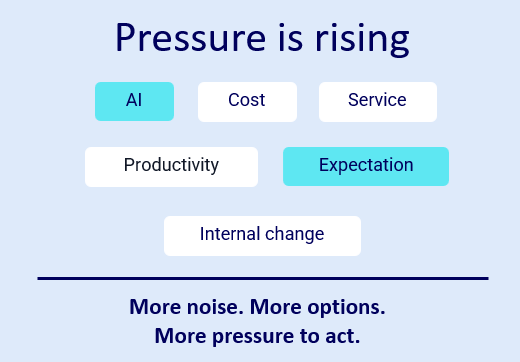
AI is now part of almost every conversation, while costs remain under scrutiny and customer expectations continue to rise. At the same time, organisations are being asked to improve productivity and service performance, manage internal change and adopt new technology, often without significantly increasing operational complexity or cost.
There is certainly no shortage of ideas or potential solutions in the market. The harder question for many organisations is deciding which of those options will actually address the underlying problem and deliver a meaningful, measurable outcome.
That is the picture emerging in our Q3 market overview: the market is active, but activity does not always translate into progress
The move from interest to pressure
AI has moved firmly into the customer operations conversation, but practical adoption remains uneven, with many organisations still working through how to translate the possibilities of the technology into specific operational improvements.
Organisations are being asked to modernise, reduce costs and improve service, often at the same time, yet many are still working through a more fundamental question: what is actually going to solve the problem?
For some, the answer may be technology. For others, it could be outsourcing, operational optimisation or consulting. In many cases, it may be a combination of several approaches, depending on the organisation’s existing capabilities, objectives and appetite for change.
The challenge is that these options are not always directly comparable, and choosing between them requires an understanding of not only what each solution can deliver, but also how it fits with the organisation’s commercial objectives, operating model and existing customer operation.
Customer operations leaders are therefore facing more noise, more options and more pressure to act, creating a growing need for a clearer way to move from a broad set of possibilities towards a decision that can actually be delivered.
The opportunity is not simply to add another option to the conversation. It is to help buyers turn that pressure into a clear, deliverable decision.
The biggest gap is decision confidence
Customer operations decisions now involve more stakeholders than ever, with commercial, operational, technology, risk, compliance and people agendas all having a role to play. While these stakeholders may share the same overall objective, their priorities and measures of success are not always aligned, making an already complex decision more difficult to navigate.
ROI is also being challenged harder, particularly as organisations look beyond the initial cost of a solution and consider its wider impact on service, productivity, customer experience, implementation and ongoing operational performance.
Where decisions could affect customer experience, brand reputation, compliance or operational performance, buyers are understandably cautious about making the wrong move.
There is another complication: some of the options being compared are not genuinely like-for-like.
A technology platform, an outsourced operating model, an internal optimisation programme and a consultancy engagement may all appear to address the same problem, but they solve it in very different ways and can require very different levels of investment, organisational change and operational commitment.
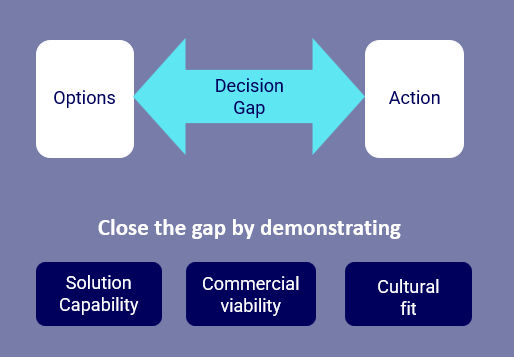
This creates what we would describe as a decision gap: there can be plenty of options on the table, but a lack of confidence about which option is actually right for the organisation, the operation and the outcome it is trying to achieve.
That changes the nature of the conversation.
The strongest conversations are not necessarily about providing more choice. They are about creating stronger decision confidence by helping organisations understand the problem, challenge the available options and establish which route is most capable of delivering the outcome they need.
From experimentation to execution
AI provides perhaps the clearest example of this shift.
Organisations are under pressure to demonstrate progress, but many are still working out where to start and, importantly, where AI can create genuine operational value rather than simply adding another layer of technology to an already complex environment.
There is no shortage of possible applications. In customer operations, some of the strongest opportunities we are seeing sit around areas such as:
- Agent assist
- Knowledge management
- Quality assurance
- Customer and operational insight
- Routing
- Forecasting
- Summarisation
- Root-cause analysis
These use cases can offer meaningful opportunities to improve how customer operations work, whether that means giving agents better information, improving the consistency of quality management, identifying patterns in customer interactions or helping organisations understand the underlying causes of operational issues.
But possibility is not the same as readiness.
Buyers are increasingly alert to the practical implications of introducing AI, including experience, compliance, accuracy, data quality, adoption and reputational risk. A use case that looks compelling in isolation still needs to work within the realities of the organisation’s data, systems, processes, people and governance environment.
This creates a growing gap between AI ambition and operational readiness, where organisations can see the potential of the technology but have not necessarily established the foundations required to deploy it effectively and responsibly.
The question is therefore changing.
It is moving away from:
“What can AI do?”
Towards:
“What should we trust AI to do?”
That is an important distinction because the value of AI in customer operations will not simply come from identifying everything that the technology is technically capable of doing. It will come from understanding where it can be applied safely, where human involvement remains important and where the resulting change can be measured against a meaningful operational or customer outcome.
Where AI creates value matters as much as what it can do
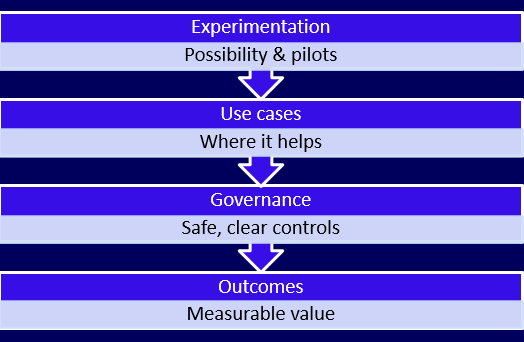
The next stage of the AI conversation is not simply about experimentation. It is about understanding where AI can be safely applied, how it changes the operating model and how its value can be demonstrated once it moves beyond the pilot stage.
That means moving through several stages.
First comes experimentation and the recognition of what is possible, followed by pilots that allow organisations to test specific ideas in a controlled environment and understand whether they translate into meaningful operational improvements.
From there, organisations need to identify the use cases where AI genuinely helps, rather than applying it simply because the technology exists or because there is pressure to demonstrate that an organisation is doing something with AI.
Governance then becomes critical.
Clear controls, sensible guardrails and appropriate oversight are needed to make sure that experimentation can become something operationally useful and responsible, particularly where AI interacts directly with customers, influences decisions or handles sensitive operational information.
Ultimately, the conversation needs to reach outcomes.
What has changed? What value has been created? Has the customer experience improved? Has operational complexity reduced? Has productivity increased? Can the result be measured?
These questions move the conversation away from technology for technology’s sake and towards the practical role AI can play within a broader customer operations strategy.
The organisations that stand out will not necessarily be those making the biggest claims about AI. They will be those able to demonstrate clear use cases, credible evidence, sensible governance and measurable outcomes, while being able to explain how those outcomes connect to the wider objectives of the customer operation.
Closing the gap
This is where the wider customer operations market is heading.
The challenge is no longer simply finding a supplier, platform or technology that could potentially solve a problem. As the number of available options continues to grow, organisations increasingly need to understand the problem properly, evaluate the available routes and build enough confidence to move from decision to delivery.
That requires a different kind of conversation.
One that starts with the ask and considers what the organisation is actually trying to achieve, rather than starting with a particular technology, supplier or predefined solution.
One that considers the operational context, commercial viability, cultural fit and capability required, recognising that a solution can look attractive on paper but still be unsuitable if it does not fit the organisation or the people expected to deliver it.
And one that recognises that the right answer may be technology, outsourcing, optimisation, consulting or a combination of approaches, depending on the problem being addressed and the outcome required.
At Customer Contact Panel, this is how we approach customer operations.
As people, we understand the value of cultural, brand and relationship fit. As natural problem solvers, we start with the ask because the ask sets the strategy, whether that ultimately leads towards improving an existing operation, introducing new technology or finding the right outsourced partnership.
From there, the focus is on helping organisations shape their contact centre operations and find the right technology or outsourced partnerships to match their ambition.
The market will continue to produce more options, while AI will continue to create new possibilities and the pressure on customer operations will continue to grow.
But organisations need more than options. They need confidence in the decision, clarity on how to execute it and evidence that the chosen approach is creating measurable value.
The opportunity is to move from market noise to better decisions, and from better decisions to safe, measurable delivery.